Global Mental Health: From Awareness to Collective Action
In time for the World Mental Health Day, members of our Global Mental Health Community reflect on the ongoing challenges in mental health and explore how collective action can help bring mental health to the forefront of the global health agenda.
Mental health is a fundamental component of health and well-being and a major global public health priority. The World Health Organization (WHO) defines health as a “state of complete physical, mental and social well-being and not merely the absence of disease or infirmity.” But there is no health without mental health — and that mental health is more than the absence of mental disorders or disabilities.
Mental Health Is a Major Global Health Burden
Mental health conditions affect people across the life course and contribute substantially to disability, premature mortality, social exclusion, and economic losses. The Global Burden of Disease study shows their substantial contribution to years lived with disability worldwide [1]. Within the WHO European Region, approximately 1 in 6 people live with a mental health condition, while 1 in 4 people with psychosis receive no formal treatment or care [2]. More than 120,000 people die by suicide each year in the region — over 300 deaths every day.
The burden extends beyond direct health outcomes. Depression and anxiety are associated with an estimated 12 billion lost working days each year and approximately US$1 trillion in lost productivity globally [3]. Mental health is therefore not only a clinical issue but also an important determinant of social and economic development.
Inequalities are evident across the life course. Among adolescents in the WHO European Region, indicators of mental health and well-being have deteriorated: more than 40% report pressure from schoolwork, 16% report cyberbullying, 1 in 5 report insufficient support from family or friends, and 1 in 4 girls aged 15 reports feeling lonely [2]. These findings underline the importance of addressing social and environmental determinants alongside individual-level interventions.
Mental Health Care Remains Underresourced
Despite this burden, mental health remains comparatively under-resourced in many health systems.
Mental health receives a relatively small proportion of health expenditure, illustrating the persistent gap between population needs and investment in promotion, prevention and treatment. For example, only 3.9% of mental health research funding goes to prevention.
Stigma and discrimination remain major barriers to seeking and receiving support as well, while substantial gaps persist in integrated and community-based mental health services. Addressing the global burden therefore requires a comprehensive public health approach that extends beyond treatment to prevention, early intervention, mental health promotion, community-based care and action on the wider determinants of health.
Our Global Mental Health Community Sets an Example for Cross-Cutting Collaboration
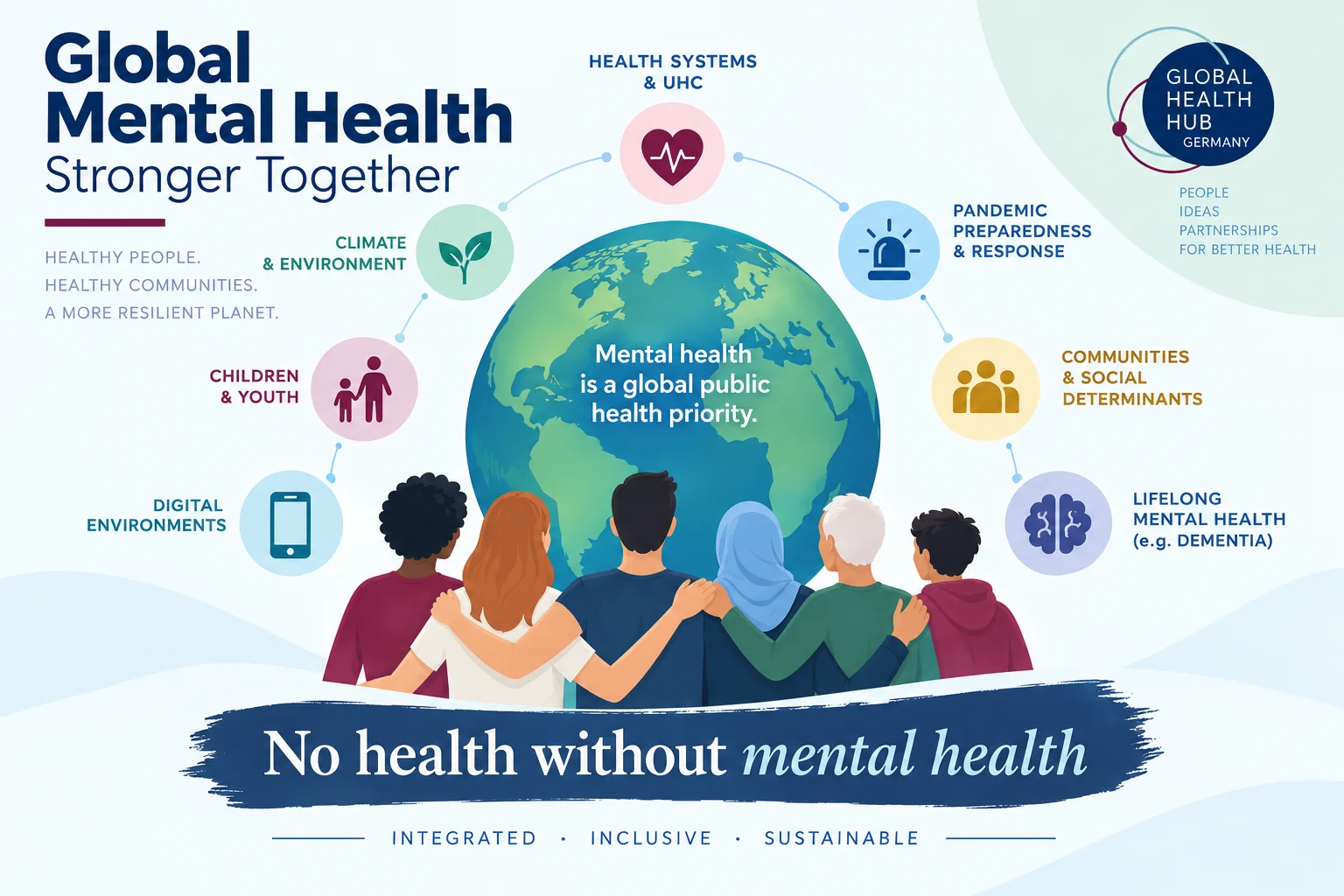
The scale and complexity of this burden also make one thing clear: mental health cannot be addressed by the health sector alone. It is shaped by crises and emergencies, digital environments, climate change and the ability of health and social systems to reach people when and where they need support. Global mental health is therefore a cross-cutting issue requiring collaboration across sectors, disciplines and borders.
The work of the Global Health Hub Germany’s Global Mental Health Community of Practice illustrates these connections. Pandemic preparedness is one example. In 2026, our community hosted a webinar with Anna Grigoryan, who shared her expertise and first-hand experience from the CDC response to the 2014–15 Ebola outbreak in West Africa, including her deployment to Sierra Leone. The discussion highlighted that outbreaks are not only infectious-disease emergencies: mental health and psychosocial support need to be integrated into preparedness and emergency response rather than treated as an afterthought.
Digital transformation raises another set of challenges. At the 2026 Global Health Talk, our community examined social media use among adolescents as a “double-edged sword”. Problematic use can negatively affect psychosocial functioning, while supportive use can facilitate social connection, emotional support, access to mental health information and a sense of belonging. Our work points to three complementary directions: empowering young people as co-actors, informing adolescents, parents and caregivers, and developing appropriate regulation and implementation mechanisms.
Climate change provides another powerful example of why mental health must be considered across global health agendas. In our 2024 Community Paper, developed with contributors from other Hub Communities, we argued that climate change and mental health are inextricably linked and called for transdisciplinary approaches that move beyond disciplinary silos. The paper also drew on research involving people living with dementia during crises as an example of how interdisciplinary and international work can contribute to more responsive and resilient health systems.
Looking ahead, Universal Health Coverage (UHC) will provide an important focus for our community. There can be no meaningful UHC if mental health is left behind. Equitable access to mental health promotion, prevention, care and support must be part of building resilient and inclusive health systems.
No Change without Collective Action
Awareness must now be translated into action. Global mental health needs sustained investment and funding, stronger political attention, and collaboration among decision-makers, researchers, health and social care professionals, civil society, communities, people with lived experience, and the private sector. No single discipline, sector, or organization can address these challenges alone.
The Global Mental Health Community of Practice provides a space to build these connections, exchange expertise and turn shared priorities into collaborative action. We invite those working within and beyond mental health to join us: bring your voice, expertise, insights and questions—and help make mental health an integral part of global health action.
Bibliography
[3]World Health Organization (2022). WHO guidelines on mental health at work.
Related Articles
![[Translate to English:] Illustration showing a diverse group of people engaged in conversation, symbolizing collaboration on mental and physical health. The background features soft blue tones with plant motifs, speech bubbles, and a heart with an ECG line, representing connection, care, and wellbeing](/fileadmin/_processed_/c/3/csm_NCD_artikel_bild_56564a7757.webp "[Translate to English:]")