Climate Crisis and Health: Every Tenth of a Degree Can Decide Between Life and Death
As Médecins Sans Frontières, we see every day how the climate crisis worsens disease, drives displacement, and overburdens health systems. Medical assistance alone is not enough.
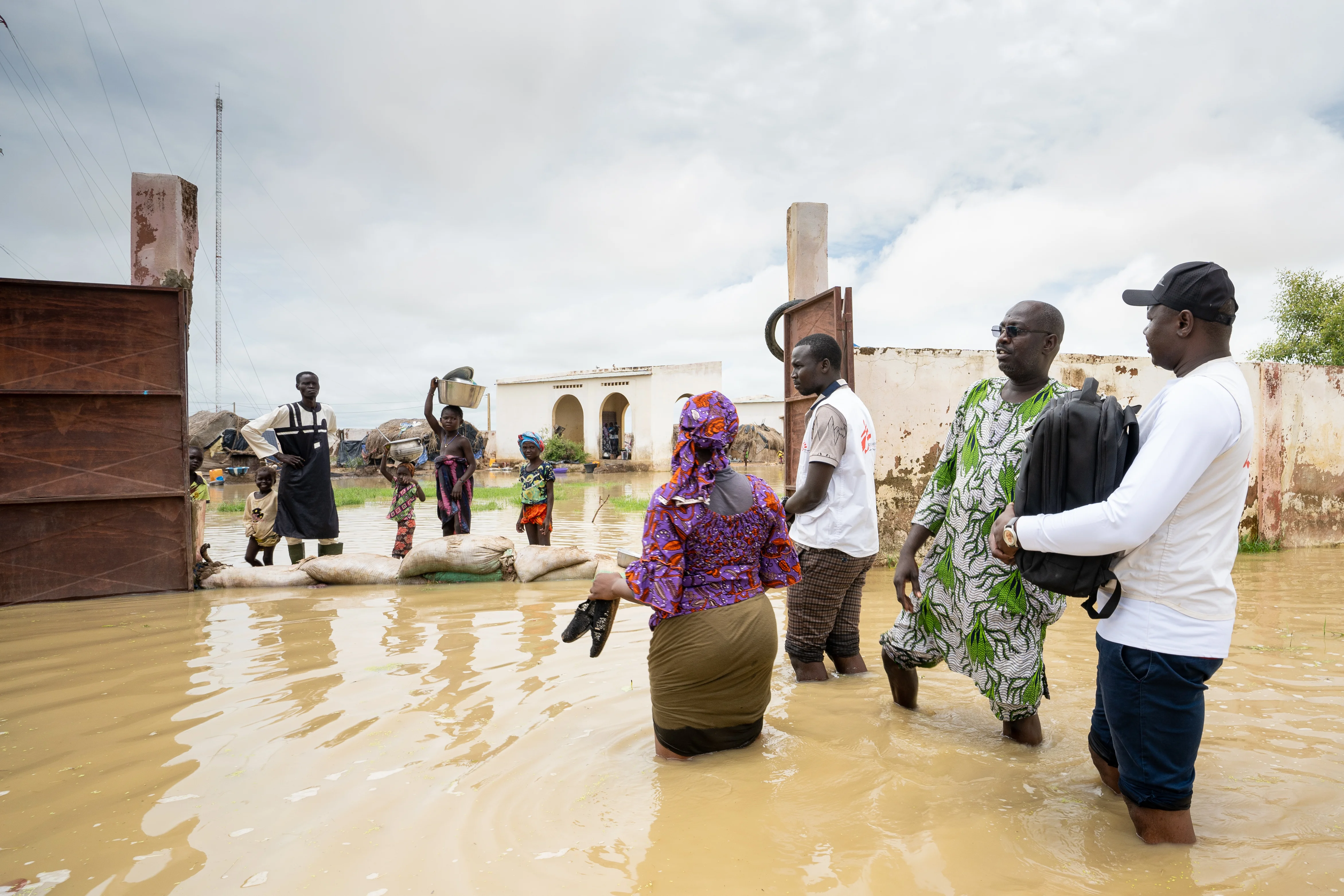
About the cover image: Every year during the rainy season, the Tenenkou district in Mali is affected by flooding. Exceptionally heavy rainfall in 2024 led to severe floods and displaced numerous families. Here, a team of Médecins Sans Frontières meets people who have lost their homes due to floodwaters.
The climate crisis is a health crisis – already today
For our patients, the climate crisis is no longer an abstract future scenario – it is already a medical reality. It manifests itself in the lack of safe drinking water, outbreaks of climate-sensitive diseases, and health systems that are unable to cope with mounting pressures. In many of the countries where we work, these impacts hit already fragile systems and structures weakened by conflict, poverty, or displacement.
We have been warning for years: the climate crisis is both a humanitarian and a health crisis – and it is escalating.
Health impacts are increasing – and not everyone is equally affected
The health consequences of this escalation are already clearly visible. After floods, our teams treat increasing numbers of diarrheal diseases, skin infections, and hepatitis as clean water becomes scarce, and sanitation systems collapse. Prolonged droughts lead to crop failures, hunger, and malnutrition – especially among children. Their immune systems weaken, making them more vulnerable to further disease. A vicious cycle.
At the same time, disease patterns are shifting. Malaria, dengue, and cholera are becoming more frequent or spreading into regions and seasons where they previously did not occur. Mental health burdens are also increasing due to repeated crises, displacement, and the loss of livelihoods – particularly for people with limited resources to cope with these enormous challenges.
These impacts are highly unequal. Low-income countries and small island states bear the greatest burden, despite having contributed least to the climate crisis. WHO analyses show that mortality rates linked to extreme weather events in highly vulnerable regions were 15 times higher than elsewhere over the past decade. Within societies, vulnerable groups – including children, older people, and people living with chronic illnesses – are disproportionately affected.
Global health risks are reaching record levels
The World Health Organization (WHO) identifies climate change as one of the greatest threats to global health. The Lancet Countdown 2025 – a leading scientific assessment on climate change and health – shows that many climate-sensitive health risks are already at historic highs. More than half a million people die each year from heat-related causes. Air pollution from fossil fuels causes around 2.5 million additional deaths annually. Yet nearly one trillion US dollars continue to flow into fossil fuel subsidies every year.
Many health systems are not prepared for this reality. Their resilience to extreme weather events, disease outbreaks, and sudden disruptions in service delivery remains limited. The diagnosis is clear: every additional tenth of a degree of warming further intensifies health impacts and increases pressure on health systems.
We are currently expecting a strong El Niño event in the coming months. Combined with an already warmer climate, it is likely to further intensify extreme weather, food insecurity, and strain fragile health systems – increasing medical and humanitarian needs in many regions.
Rising needs – shrinking capacity to respond
From a humanitarian perspective, the climate crisis not only increases needs. It also acts as a crisis multiplier and makes it harder to deliver life-saving assistance. Climate shocks often intersect with existing crises – such as conflict, epidemics, or displacement – further compounding their impacts. In many of the countries where we work, crises hit one after another, leaving communities and systems no time to recover.
In the Sahel, recurring droughts drive water and food insecurity and heighten social tensions. In South Sudan, floods, disease outbreaks, displacement, and violence overlap, with devastating consequences for communities. In the Philippines, typhoons destroy roads, disrupt supply chains, and damage health facilities. Our teams often reach patients only after significant delays.
For humanitarian organizations, this means rising needs, more complex and costly operations, and simultaneously shrinking funding for humanitarian and health responses from key donors, including the United States and Germany. While Médecins Sans Frontières remains independent from government funding thanks to private donations, we see entire health and aid systems erode when external support collapses while needs continue to rise. No single organization can fill these gaps.
Somalia – drought as a medical emergency
The current drought in Somalia shows how quickly the climate crisis becomes a medical emergency. Four consecutive failed rainy seasons have pushed millions into acute crisis. More than 6.5 million people – around one in four – are facing food insecurity.
In health facilities supported by our teams in Baidoa, we are treating some of the highest numbers of severely malnourished children in years. Even before the peak of the lean season, more children arrive than we can treat. Many are already in critical condition. Others must be discharged earlier than is medically appropriate – returning to households without sufficient food or clean water. In some cases, it is already too late, and children die from the consequences of malnutrition. Nationwide, more than 1.8 million children under five are expected to suffer from acute malnutrition this year.
At the same time, the risk of waterborne diseases is rising as people rely on unsafe water sources. Our teams respond with medical care, nutrition programmes, and water, sanitation and hygiene interventions. At the same time, essential services are being scaled back elsewhere: around 200 health facilities and 300 nutrition centres were forced to close last year in Somalia – not due to lack of need, but due to lack of funding.
Adapting, anticipating, innovating
To respond effectively within a changing climate, we are adapting our work. We are increasingly integrating climate-related risks into project planning – for instance through risk and vulnerability analyses, and adjusting our operational strategies in highly climate-vulnerable settings.
This highlights how closely health and environment are interconnected – a core principle of the One Health approach. In Kiribati, for example, rising sea levels are salinizing freshwater sources and threatening drinking water supplies. Médecins Sans Frontières supports access to safe water to reduce the health impacts of these environmental changes.
A key priority is strengthening data and early warning systems to enable earlier action. A heat monitoring tool developed by our teams can anticipate extreme heat events up to ten days in advance. It is currently being tested in several countries and allows us to adjust staffing, infrastructure, and care provision before heat-related disease peaks. Similar approaches are used to predict malaria surges and reduce morbidity and mortality.
We are also testing new approaches to controlling climate-sensitive diseases. One example is the Wolbachia method against dengue, piloted with partners in Honduras. Mosquitoes infected with Wolbachia bacteria are less able to transmit the dengue virus to humans. Early results are promising and demonstrate how innovation can be part of climate adaptation.
Political action is urgently needed – and implementation must be accelerated
Humanitarian and medical assistance can alleviate acute suffering and save lives – but it cannot make up for structural shortcomings. Without a shift in political direction, the gaps will widen faster than they can be closed.
This is why political decisions are required that reflect the true scale of the crisis and address its root causes. Germany bears particular responsibility – as a globally recognized actor in humanitarian assistance, global health, and international climate policy. What is urgently needed is investment in climate-resilient health systems, decisive climate action, reliable climate finance, and targeted support for the countries and communities most affected.
The recent climate intersessional negotiations in Bonn (SB64), which took place over the past two weeks to prepare for the upcoming UN Climate Change Conference (COP31), once again concluded without meaningful progress. In key areas such as adaptation finance and emissions reductions, negotiations ended in deadlock.
While health is receiving increasing attention in international climate negotiations, this is still not enough. What is needed is a consistent integration of climate and health policy and its concrete implementation. Health must remain central to the international climate debate – including at COP31 in Antalya this November.
What is politically neglected today will become tomorrow’s health emergency. In our projects, this is already reality. And every day, we see who pays the price.
We asked Alina Seebacher from Doctors Without Borders / Médecins Sans Frontières Germany to share thoughts and experiences on the relation between climate change and health with us. The views expressed are her own and do not necessarily reflect those of Global Health Hub Germany.
Related Articles
![[Translate to English:]](/fileadmin/_processed_/8/6/csm_N4G_Summit_fe58247b9f.webp "[Translate to English:]")
![[Translate to English:]](/fileadmin/_processed_/a/4/csm_WHS_Titelbild_01_ec752cef53.webp "[Translate to English:]")