Global Health at a Crossroads: Africa’s Response to a Changing Global Health Ecosystem and Financing Part 1
![[Translate to English:]](/fileadmin/_processed_/8/c/csm_freepik_Titelbild_5df1dc9ed6.webp "[Translate to English:]")
In our new article series “Global Health at a Crossroads,” we explore how shifts in global governance, financing, and power are reshaping health and development outcomes worldwide. In this edition, we speak with Dr Ebere Okereke.
The global health ecosystem is undergoing profound transformation. Declining development assistance, geopolitical fragmentation, and mounting fiscal pressures are reshaping how health is financed, governed, and prioritised. For African countries, these shifts are not abstract. They cut directly to questions of health sovereignty, national ownership, and the ability to protect populations against current and future health threats.
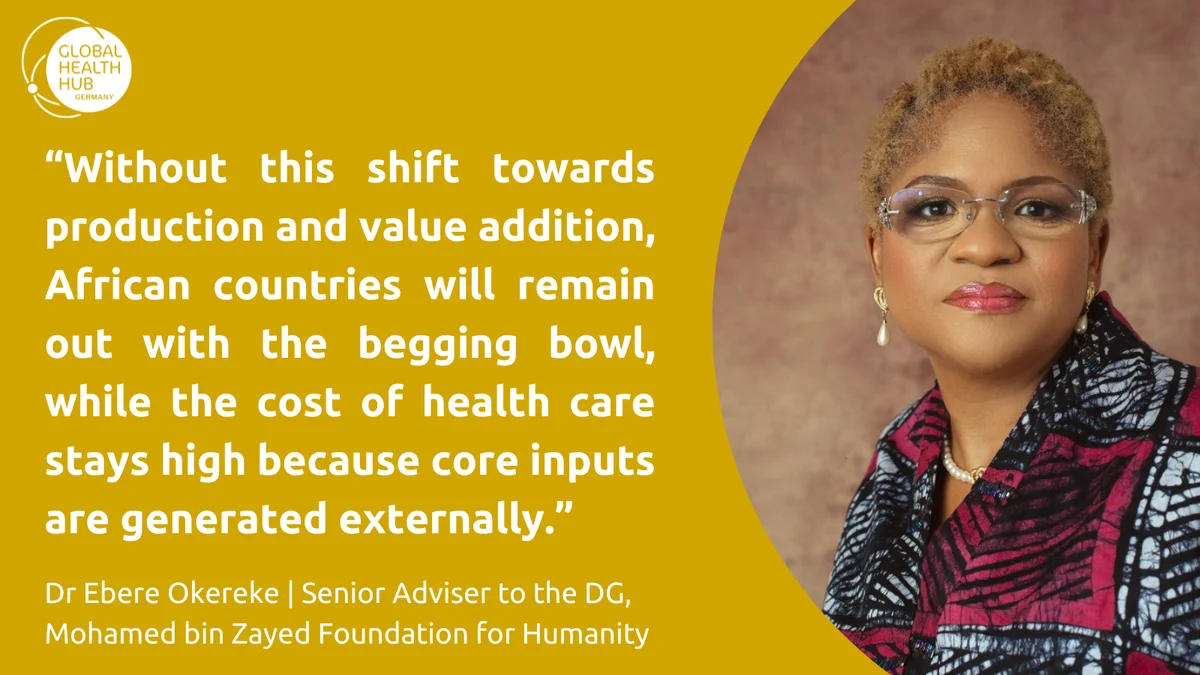
In this first part of a two-part edition, we focus on insights from Dr Ebere Okereke, a global health policy expert, former CEO of the Africa Public Health Foundation and Senior Adviser to the DG, Mohammed bin Zayed Foundation for Humanity. Dr Okereke is speaking in her personal capacity.
From dependency to health sovereignty
As global shifts expose long-standing vulnerabilities, they also sharpen an overdue question: what would it take for Africa to move from dependency to genuine health sovereignty?
For Dr Okereke, the starting point is rejecting the idea that Africa’s reliance on external health financing is accidental or inevitable. “Some of the so-called dependence on donor assistance,” she argues, “has actually been built into an architecture that was not designed for African agency.” This architecture extends beyond health into global trade, debt, and financial rules that systematically constrain African economies. “We can’t explore health financing without exploring the whole global economic system, and how African nations have been deliberately kept dependent on an ecosystem.” Dependency is not simply about aid volumes, but about who sets priorities, who controls resources, and who bears risk. “African heads of government need to stop reacting to the global ecosystem and start setting the agenda for their own citizenry,” she emphasises.
Health is not a black hole, it is an investment
Central to Dr Okereke’s argument is a reframing of health spending. Health, she insists, is not a discretionary sector to be funded when resources allow, but a core state obligation grounded in the right to health. Historically, health expenditure has been treated as consumption rather than investment, reinforcing its marginalisation in national budgets. “The perception is that it’s a black hole,” she notes. “You put money in, nothing comes out.” Changing this narrative requires not only highlighting the economic returns of prevention, immunisation, and strong primary health care, but also by recognising the broader value chains opportunities the health sector can unlock. The health ecosystem is inherently innovative, producing “a new product, a new solution, a new intervention every year.” While some duplication is inevitable, innovation creates openings for jobs, investment, and domestic value if countries position themselves to capture it.
This leads to a deeper challenge: Africa’s structural position as a consumer rather than a producer. “Across the board, the African ecosystem is predominantly a consumerist one, even for products whose raw materials come from our own soil.” Local value addition, she argues, starts with investing in research and development infrastructure. She describes speaking with researchers and scientists who generate promising ideas, only to “practically give away the IP because there is no funding to support them to grow that.” Many medicines and medical devices are also no longer under strict intellectual property controls and could be produced locally, yet systems remain locked into import dependence.
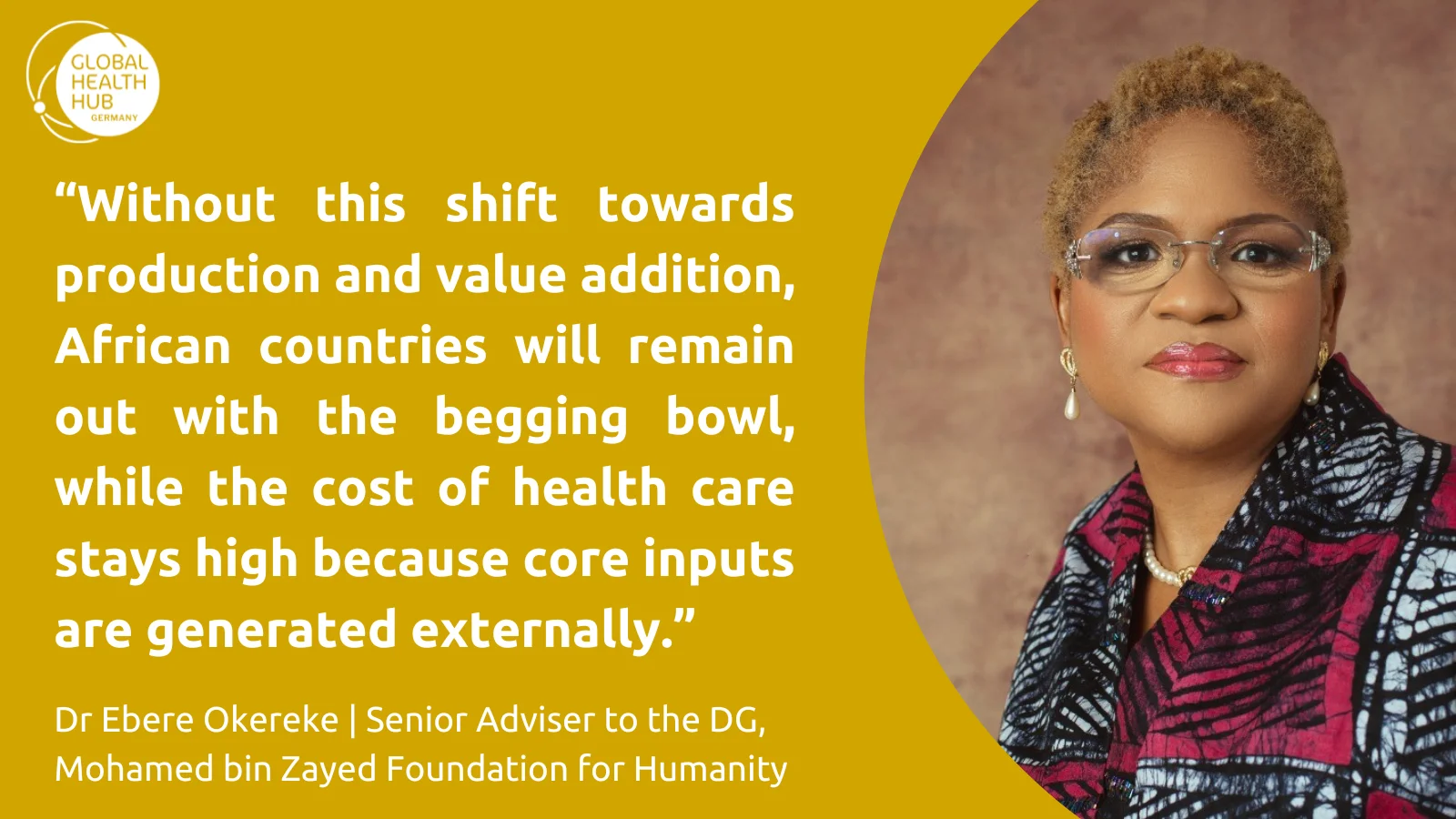
“If we are truly interested in changing the narrative,” she argues, “we need to start seeing healthcare not just as something that absorbs funds, but as something that actually generates income for the country.” Without a shift towards production and value addition, African countries remain vulnerable to high costs and external shocks. This logic supports continental manufacturing ambitions championed by the Africa Centres for Disease Control and Prevention (Africa CDC), including the Platform for Harmonised African Health Products Manufacturing, which aims to raise vaccine production on the continent to 60% by 2040. The target is ambitious, Dr Okereke notes, but necessary if the continent is to reduce vulnerability and long-term costs.
Health sovereignty beyond the health ministry
This reframing makes clear that health sovereignty cannot be delivered by ministries of health alone. For Dr Okereke, both the problem and the solution lie well beyond the health sector. Fiscal rules, debt obligations, trade policy, and macroeconomic decisions shape available fiscal space long before health strategies are even discussed. It demands a whole-of-government approach, cross-sectoral alignment, and stronger collaboration across African agencies. While the Africa CDC plays a critical technical role, it cannot resolve structural market and trade constraints. Market shaping depends on institutions responsible for trade, transport, and the free movement of people and goods, including the African Continental Free Trade Area architecture. With only a handful of countries large enough to sustain viable health markets alone, cross-continental cooperation is essential. As she puts it, “It is currently easier for Nigeria to trade with the UK than with Ethiopia.”
At the same time, she stresses the urgency of strengthening Africa’s negotiating capacity as global health relationships become increasingly transactional. “Some of the bilateral negotiations we are seeing suggest a move away from global health as a public good towards very transactional arrangements tied to trade leverage.” Africa, she argues, must recognise its assets and negotiate accordingly. “We have access to resources and raw minerals that the world wants. We need to get better at negotiating the terms, and we need to stop negotiating in silos.” She points to the European Union as an example of collective bargaining power. “They negotiate as a body because they recognise strength in numbers.” Health financing and health security, she argues, must be treated as foreign policy issues, led through coordinated, cross-government engagement rather than fragmented sectoral talks.
Domestic resource mobilisation: beyond slogans
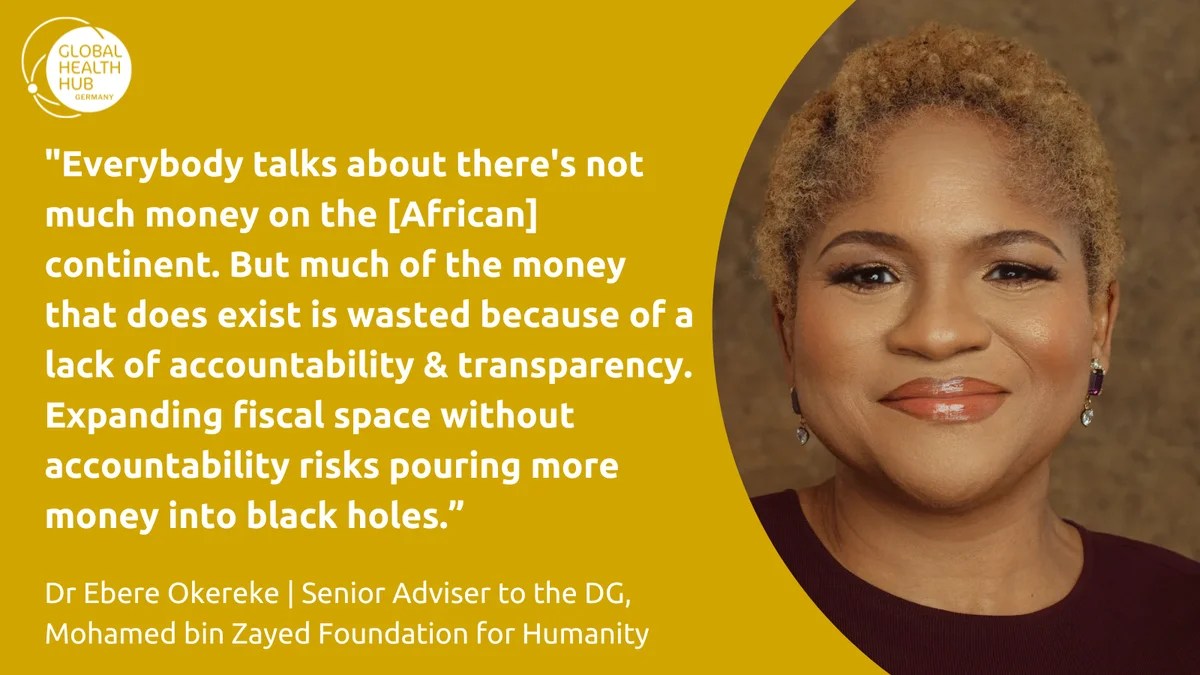
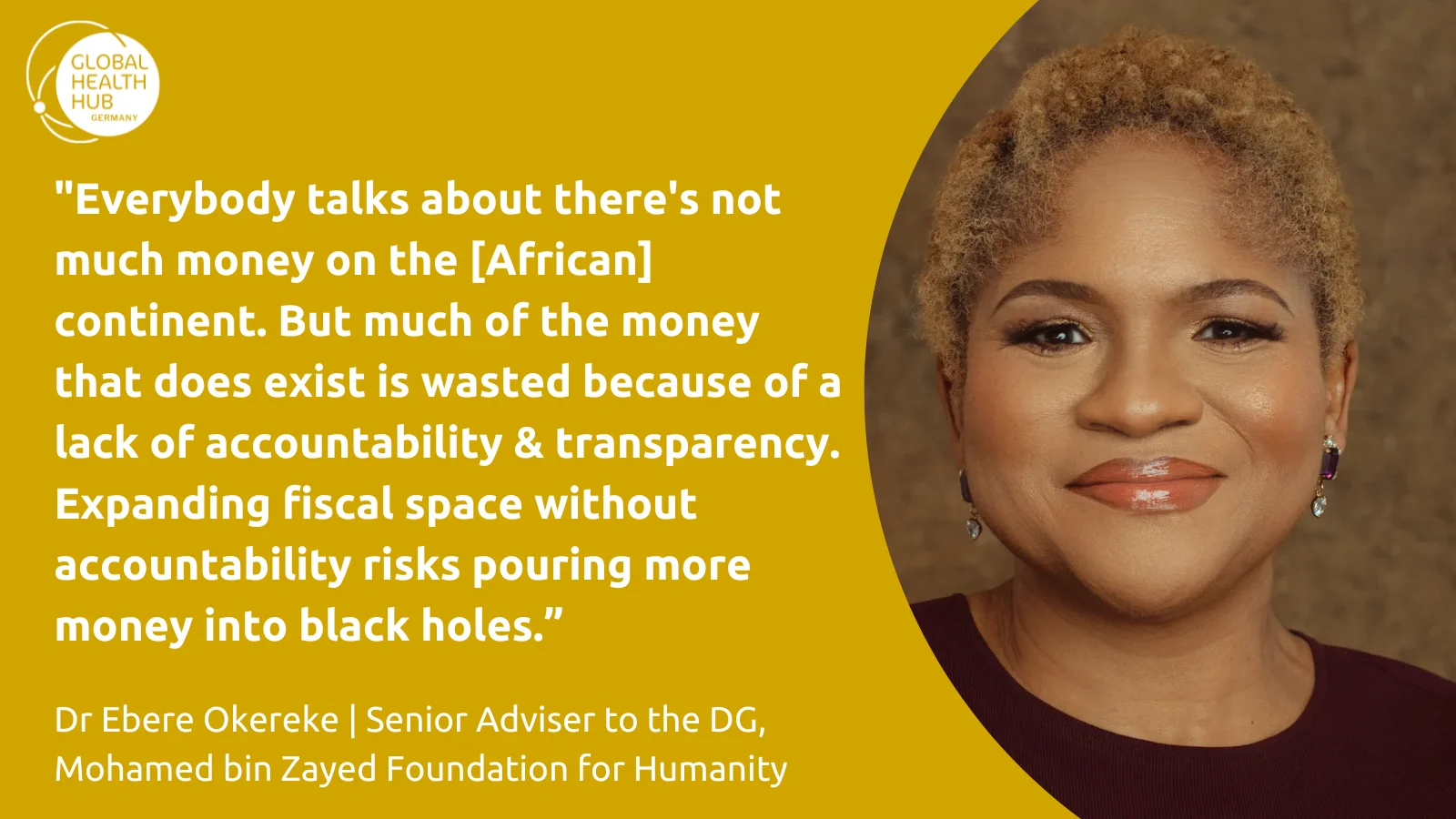
Domestic resource mobilisation now sits at the centre of African health policy discourse, including the Africa CDC’s three-pillar financing strategy combining domestic resources, innovative financing, and blended finance. Dr Okereke sees value in this direction but is blunt about the gap between ambition and delivery. Political commitments such as the Durban Promise signal momentum but do not, on their own, shift budgets or power relations. “We’ve been calling these mechanisms ‘innovative’ for 30 years. They are no longer innovative.” The problem is not ideas. It is execution. Tax reforms, debt swaps, and earmarked levies, she argues, will not deliver results without deeper governance reform. Weak tax administration, large informal economies, and low public trust constrain revenue collection, while poor transparency allows resources to leak. Expanding fiscal space without accountability risks “pouring more money into black holes.” Digitalisation, stronger public financial management, and effective oversight are therefore prerequisites for meaningful domestic health financing.
These challenges are compounded by structural constraints in the global financial system. By 2025, Africa’s debt repayments are projected to reach around USD 81 billion. In 2023, the continent received USD 74 billion in aid but lost more than USD 90 billion to illicit financial flows and USD 55 billion to corporate tax exemptions. “These dynamics limit policy sovereignty,” she stresses. Without addressing them, calls for increased domestic spending risk becoming politically unrealistic or socially regressive. Dr Okereke reiterates the case for collective leverage, including coalition-building beyond the continent with others facing similar power asymmetries, as seen during pandemic treaty negotiations and emerging Africa-Caribbean partnerships led by Barbados and Rwanda. “We are the global majority,” she argues, and that strength must be used. “Collective bargaining has significant advantages when you are trying to change a system that was not designed for your advantage.”
Rethinking donor models, or rethinking recipient models?
Fragmentation of external assistance remains a major barrier to health sovereignty. In many African countries, more than half of health aid bypasses government budgets, sometimes reaching 80%. Dr Okereke acknowledges that global health initiatives such as the Global Fund and Gavi have saved lives and delivered large-scale impact. But she questions what happens when instruments designed as emergency responses become permanent. “These initiatives were supposed to be transitional,” she explains, “to help countries build capacity and then hand back responsibility. Instead, they have become self-perpetuating.” Reform discussions under the Lusaka Agenda raise the difficult but necessary idea that global initiatives should eventually “do themselves out of business,” not because they are unimportant, but because permanent parallel systems undermine long-term institutional architecture.
At the same time, she challenges the framing of “rethinking donor models” itself. The more important question, she argues, is how countries build credible investment cases and national frameworks that enable partners to invest in existing systems rather than (re)creating them. She points to the scale of resources already flowing through out-of-pocket spending, the diaspora, and health tourism, and emphasizes that the task is to channel these more effectively. She also highlights the need to disincentivise these parallel systems. When NGOs or international actors do not pay taxes while operating alongside local private sector providers, this can disadvantage local capacity and distort markets.
A narrowing window for strategic choice
As global health financing becomes more transactional and fragmented, African governments face a narrowing window for strategic choice: continue adapting to externally set priorities, or assert a proactive vision grounded in national ownership, regional cooperation, and accountable governance. Bilateral agreements linking short-term funding to long-term commitments on data sharing and manufacturing, particularly in the context of pathogen access, illustrate the risks of negotiating from a position of vulnerability. While acknowledging the immediate pressures facing governments dependent on external funding, Dr Okereke warns against short-term decisions that mortgage future policy space. “This is not an election-cycle issue,” she stresses. “It is about the future of your citizenry.” For her, the path forward is demanding but clear. Health sovereignty requires political courage, cross-sectoral leadership, and sustained investment in national systems. “Just because it is hard,” she reminds us, “does not mean it cannot be done.”
Part 2 of this series edition will explore how African-led research, innovation, and regional collaboration can translate this vision of sovereignty into practice, drawing on insights from Prof. Christian Happi and his experience at the forefront of epidemic response and genomic science.
©Cover photo: Designed by Freepik
Related Articles