Global Health at a Crossroads: Africa’s Response to a Changing Global Health Ecosystem and Financing (Part 2)

In the article series “Global Health at a Crossroads,” we explore how shifts in global governance, financing, and power are reshaping health and development outcomes worldwide. In this edition, we speak with Prof. Christian Happi.
In the second part of this series edition, we interrogate how African countries can translate the rhetoric of self‑reliance into concrete systems for research, innovation, and pandemic preparedness, drawing on insights from Prof. Christian Happi, a leading genomic scientist and one of TIME’s 100 Most Influential People of 2025. His core message is clear: Africa has the capability and assets, but it must build the ecosystem and incentives that allow those strengths to translate into power and self-reliance.
A hard reset on development assistance, responsibility, and priorities
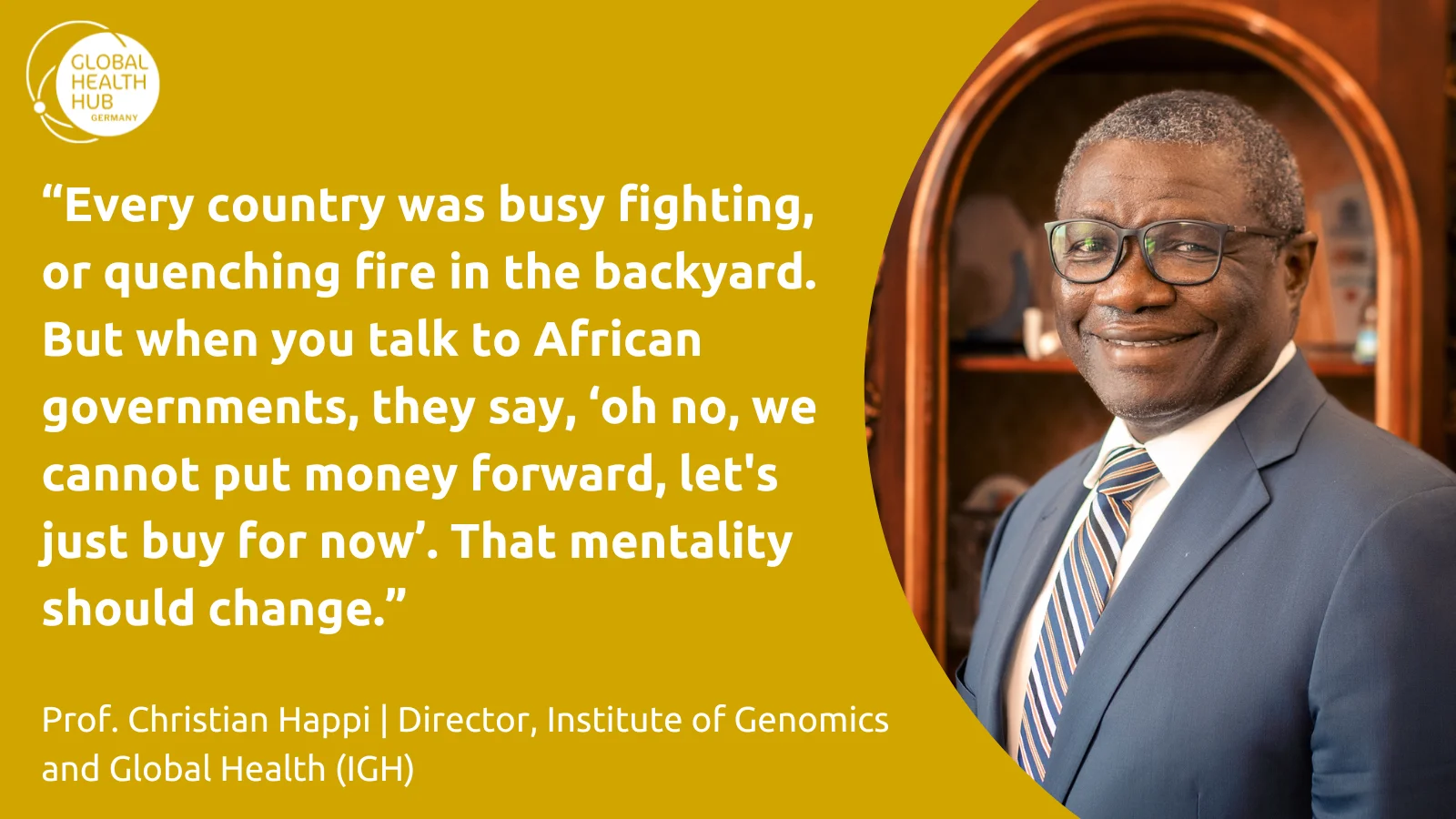
The retreat of major donors, including the United States’ withdrawal from multilateral health institutions, has exposed long-standing vulnerabilities in Africa’s health landscape. This shift is widely framed as an impending threat. However, Prof. Happi does not view this shift as a betrayal, but as an expected realignment of donor priorities. “Countries like the US and countries in Europe are in their full right not to contribute or not to continue to support Africa,” he argues. “If you got a fire in your backyard, you're supposed to quench it first.” The more uncomfortable truth, in his view, lies in Africa’s response to decades of external support. “Because Africa has been supported for all these decades, they’ve become addicted to it. It has become more or less like a right, which is very wrong."
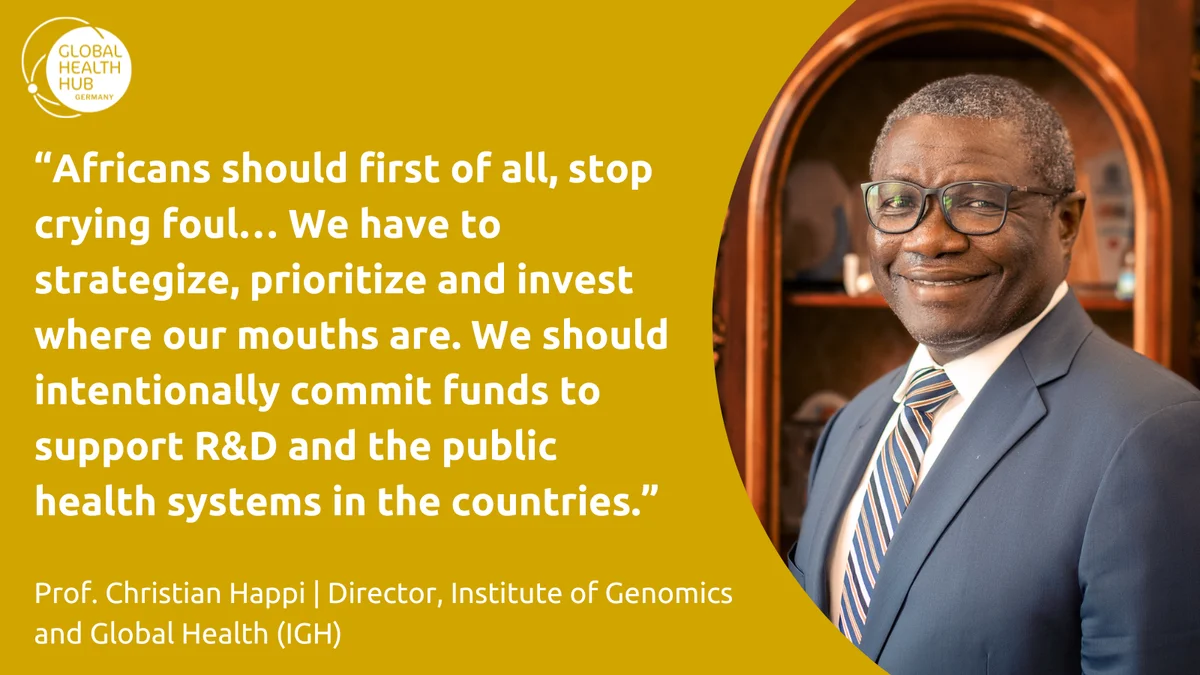
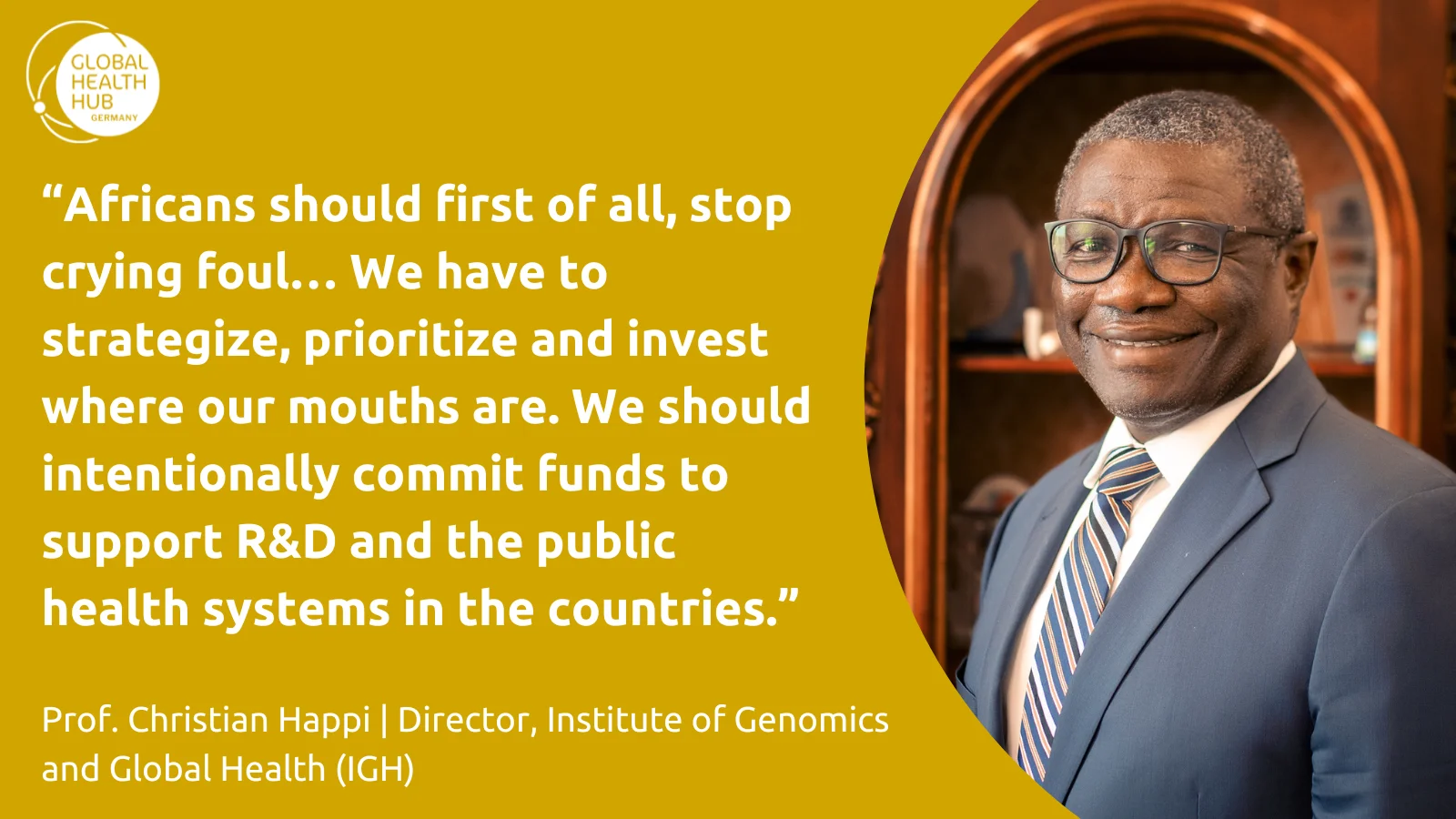
This dependency, he contends, has weakened domestic accountability and distorted political incentives. Declining aid exposes chronic underinvestment in domestic research and development, as well as a lack of political will to prioritise public health systems. The central question is not whether aid is declining, but whether African states are prepared to replace it with intentional domestic investment. “It’s not that Africa doesn’t have the resources to solve these problems,” Prof. Happi insists. “The question is whether Africa is willing to prioritize the use of its resources to intentionally address the continental challenges without waiting for outside support.”
Historical comparisons reinforce this argument. Several East and Southeast Asian economies built industrial and innovation capacity with far less external assistance. “Necessity is the mother of invention,” he notes. “If Africa had not received aid for all these years, we might not be where we are today.” Whether or not one accepts the full comparison, the core claim remains difficult to dismiss: prolonged reliance on aid has reduced the urgency of domestic reform.
The missing ecosystem: why African innovation struggles to scale
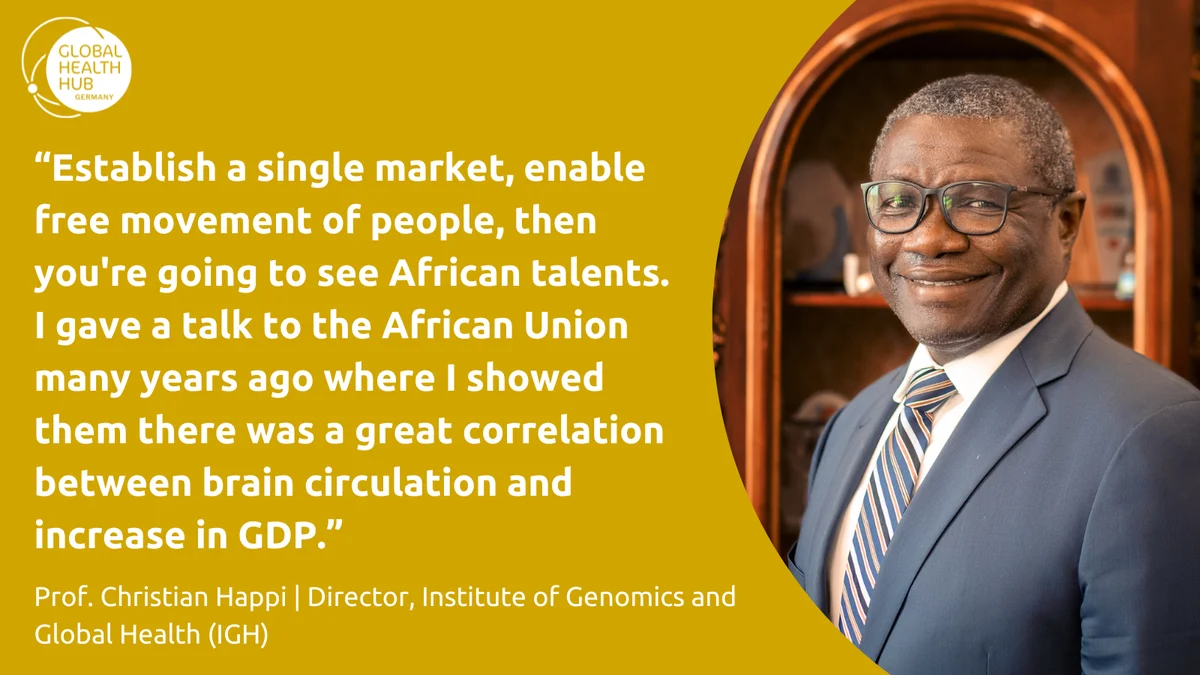
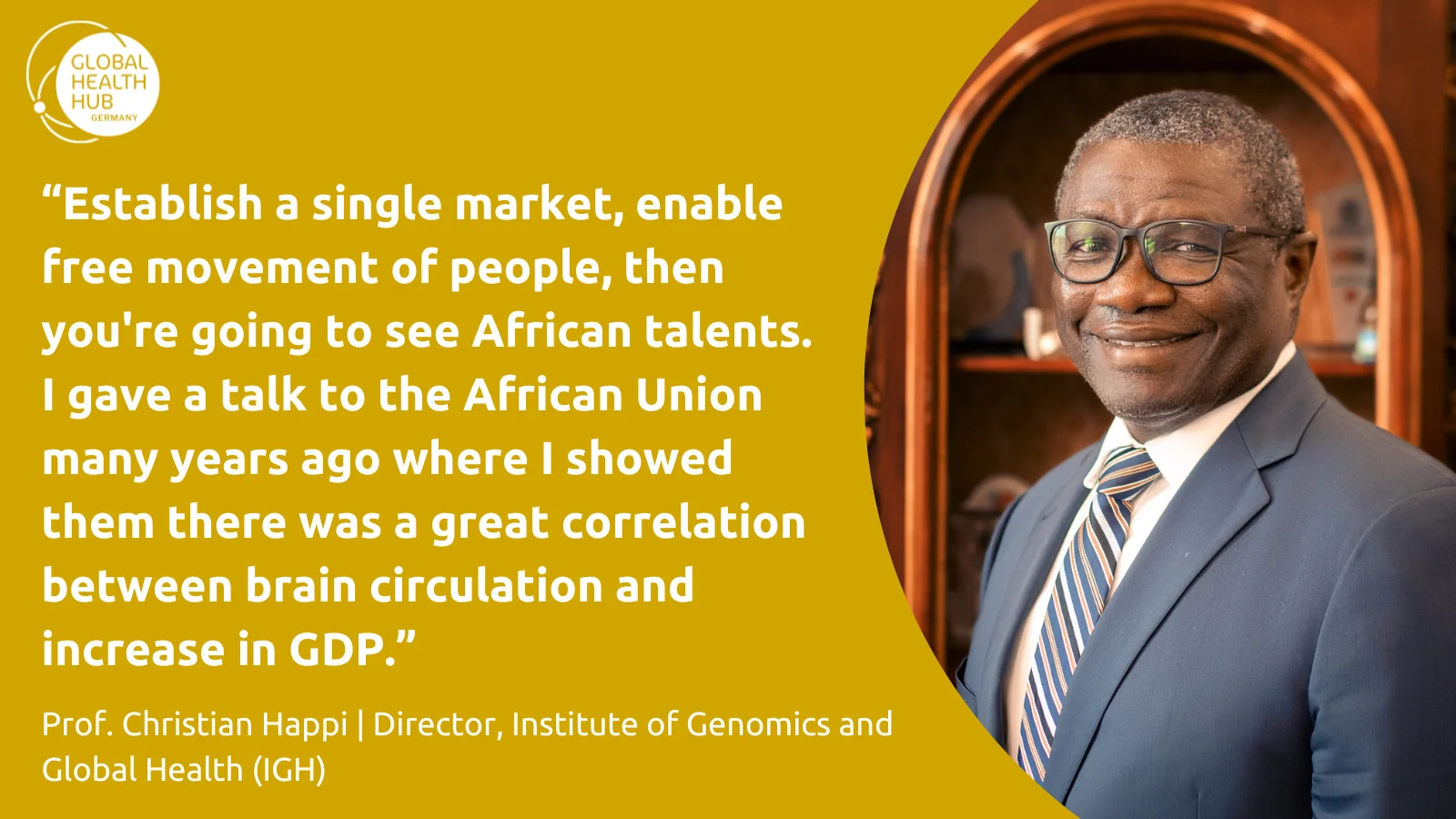
Africa’s innovation challenge is often misdiagnosed as a lack of talent. In reality, the continent suffers from a fragmented ecosystem that actively obstructs innovation. Prof. Happi makes it clear: “How do you do R&D in an ecosystem when knowledge of brain circulation is completely blocked and completely bordered?” He contrasts Africa’s restricted mobility with integrated research spaces such as the United States and the European Union, where people, knowledge, and goods move with relative ease. Africa remains divided by rigid borders inherited and later reinforced after independence by self-centred leadership.
The consequences are tangible. Moving scientists and knowledge, samples, or basic goods across African borders is often harder than shipping them outside the continent. “If I develop a vaccine in Nigeria, how do I move it to Tanzania? Is that possible, if I cannot easily move banana from Nigeria to Benin Republic, or Cameroon to Nigeria?” he asks. This fragmentation undermines every stage of the innovation pipeline: from collaborative research and clinical trials to manufacturing, regulation, and distribution. Continental initiatives such as the African Continental Free Trade Area offer a framework to address these barriers, but implementation remains uneven and politically fragile.
Investment without accountability is not sovereignty
A central insight in Prof. Happi’s argument is that Africa’s problem is not the absence of resources, but the absence of accountability. He rejects claims that high debt levels make domestic investment in research impossible. “Does debt prevent African leaders from looting public resources and keeping them overseas?” he asks. Corruption, capital flight, and weak fiscal governance erode far more potential investment than debt servicing alone. “If we are transparent and accountable, Africa has the resources to address its problems,” he argues.
Health sovereignty, in this framing, is inseparable from governance reform. Domestic resource mobilisation without transparency risks replicating the failures of aid dependence under a different label. Sustainable financing for research and innovation requires deliberate political choices: taxing value addition, negotiating fair extraction contracts, and reinvesting proceeds into public goods. The example of cocoa production is illustrative. West African countries produce a vast majority of the world’s cocoa yet capture only a fraction of its value. The majority of the profit comes after transformation. Exporting raw materials while importing high-value finished products is not only an industrial failure, but also a health financing failure. Local value addition expands the tax base, creates jobs, and generates fiscal space for investment in research institutions, manufacturing capacity, and preparedness infrastructure.
Rethinking financing and the role of the private sector
Health sovereignty also demands a broader approach to innovation financing. Prof. Happi points to Africa’s biodiversity as an underexplored strategic asset. “Africa is the continent with the largest biodiversity in the world,” he notes. “What are we doing with it?” From traditional pharmacopoeia to biotechnology, the potential for value creation is vast, yet largely untapped.
Equally significant is the role of the African private sector, which often favours high-profile philanthropy abroad over sustained investment at home. “Many of them donate to institutions like Harvard or Cambridge,” he observes, “but not at the same level to African institutions to promote R&D.” This, he stresses, is not only a government failure. “The private sector is deeply implicated.” If sovereignty is the goal, domestic capital must treat African science as investable. This requires regulatory certainty, public-private co-investment, and clear political signals that research and innovation are national priorities rather than donor-driven projects.
Sentinel: proof that African‑led solutions work
If Africa’s capacity to innovate is in doubt, the continent’s epidemic response record offers a powerful counter‑argument. Prof. Happi’s laboratory in Nigeria sequenced SARS-CoV-2 within 48 hours during COVID-19, developed early diagnostics, and advanced vaccine candidates. He recounts how his team pioneered CRISPR-based diagnostics for Lassa fever, Ebola, and later COVID-19. Yet when it came time to scale production, resources were lacking. Vaccine candidates advanced rapidly, but governments prioritised emergency procurement over investment in local trials and manufacturing.
Sentinel, the epidemic intelligence system co-founded by Prof. Happi, demonstrates what is possible. Its deployment during Nigeria’s 2014 Ebola outbreak helped contain a potential catastrophe in Lagos within 92 days and later supported Rwanda’s response to the Marburg fever outbreak in 2024. Sentinel pioneered real-time sequencing, open data sharing, discovered variants of concern, and brought in translational genomics approaches that later became central to global COVID-19 response. “These systems were built on speed and accuracy,” he explains. Real‑time genomic surveillance, open data sharing, and translational research enabled rapid decision‑making and targeted interventions.
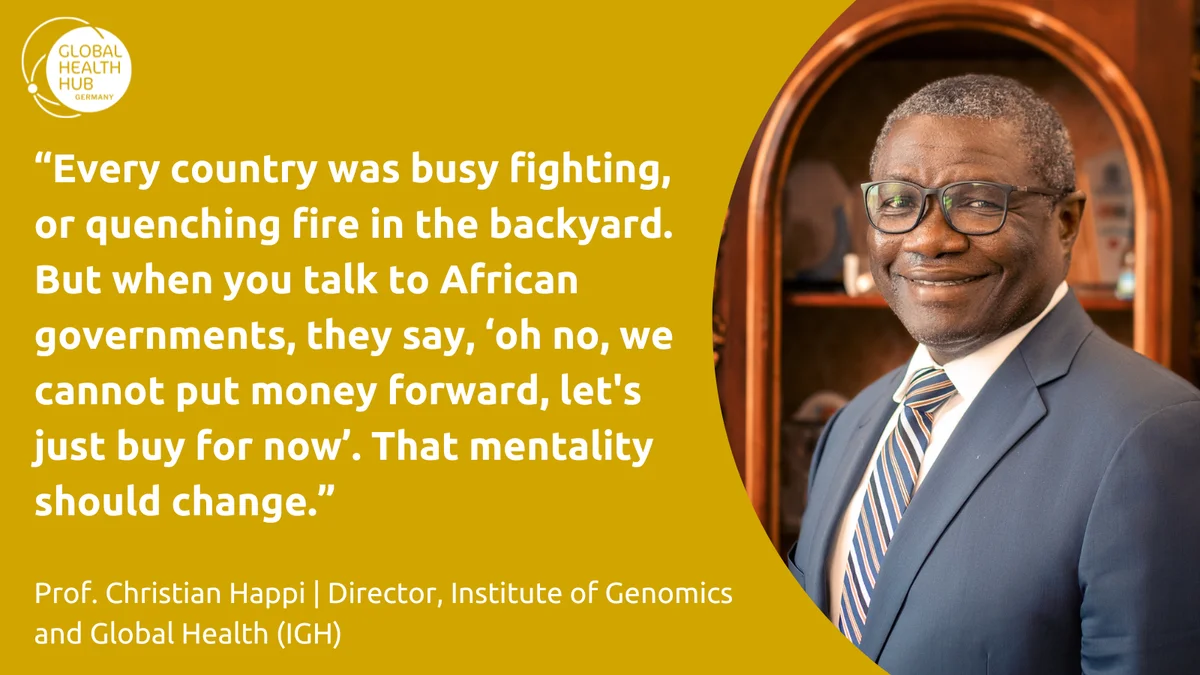
Yet these successes were not institutionalised at continental scale. “Did Africa absorb it? Did we scale it up? Did we make it a continental platform? The answer is no.” The problem, he argues, is not technical performance but political ownership. African innovation too often remains episodic, activated during crises and abandoned once pressure recedes. “We are always ready to fetch solutions from outside,” he says, “even when we have them in front of us.”
Pathogen data, power, and negotiating from strength
Negotiations on pathogen access and benefit sharing have become a flashpoint in global health diplomacy. Prof. Happi rejects narratives that portray African governments as helpless in these bilateral negotiations. “Are they putting guns on their head to agree?” he asks. He reframes pathogens and pathogen data as strategic assets. “70% of pathogens with pandemic potential are on this continent,” he highlights. “We own them. From this position, he argues that African governments should set the terms of collaboration, including African-owned data infrastructures and virtual trusted collaborative research environments and shared benefits.
He is also critical of representation. Too often, technical negotiations are attended by non-technical delegations. “We send civil servants who know nothing about genomics to negotiate on behalf of the continent,” he says. “Why don’t we put our best scientists in the room?” For Prof. Happi, technical sovereignty depends on scientific credibility at the negotiating table.
Three practical recommendations: integration, mobility, investment
Prof. Happi’s recommendations are structural rather than technical.
First, fully implement the African Continental Free Trade Area. “If there are raw materials in Cameroon or Angola, and we need them for R&D in Nigeria, how do we get them?” he asks. A functioning single market is not only about trade, but about enabling research supply chains, manufacturing inputs, and regional scale.
Second, enable genuine brain circulation. “If you have a very smart guy in Zimbabwe that can contribute to important research in Nigeria, how do I get him in Nigeria?” Innovation requires concentration of talent. Administrative and political barriers that prevent African scientists from working together directly undermine productivity on the continent.
Third, governments must intentionally and consistently invest in research and development. “We know how to make declarations, but after the declarations, we’ll go back and sit down”. Solving problems is not by speeches, it is by action.
He rejects false choices between sovereignty and partnership and is clear that he supports partnership with the global North, but only on equitable terms. Africa needs partnership, he emphasises, but on respectful and equitable terms.
Acting before the next crisis
Preparedness cannot be built during crises. Investments in surveillance, research, and manufacturing must be made in times of relative stability. COVID-19 demonstrated that Africa can lead in global health security. The unresolved question is whether political systems will allow scientific capacity to translate into lasting structural power.
Health sovereignty, in Prof. Happi’s view, should not be a slogan. It should be the cumulative outcome of decisions about borders, budgets, and beliefs. Africa’s limitation is not scientific capacity, but the ecosystems that prevent that capacity from scaling. As he puts it bluntly, “Look inwards, stop complaining and fix the problem.” In a global health order increasingly shaped by power and self-interest, sovereignty will not be granted. It must be deliberately constructed. The window is open. Whether it closes unused is a choice Africa cannot afford to make.
Part 1 of this edition explores Africa’s pathway to health sovereignty through a whole-of-government approach beyond the health sector, rethinking recipient models, political leadership, and financial accountability, drawing on insights from Dr Ebere Okereke.
Related Articles

![[Translate to English:]](/fileadmin/_processed_/8/c/csm_freepik_Titelbild_4d8392c06a.webp "[Translate to English:]")