Experience Report of the German Youth Delegate to the 79th World Health Assembly (WHA)
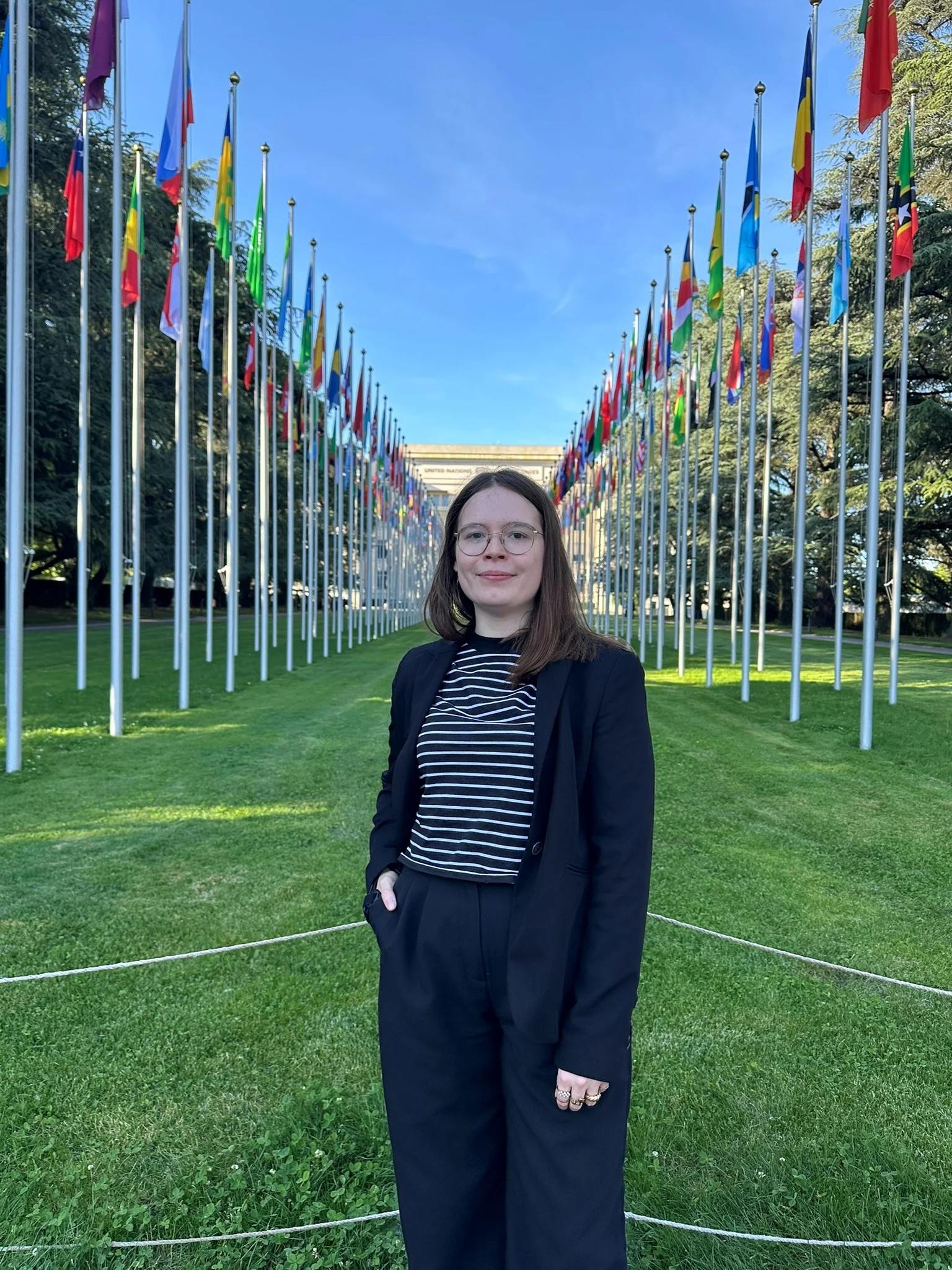
Amélie Belosevic, Youth Delegate to the 79th World Health Assembly, shares her experiences as a youth delegate.
The most labor-intensive part of my time as a youth delegate, and certainly the one that interests most people, was the 79th World Health Assembly (WHA) in Geneva. In addition, however, my mandate also included youth consultations, the World Health Summit, the WHO Regional Committee, and preparatory work at the Federal Ministry of Health (BMG) and the Deutsche Gesellschaft für Internationale Zusammenarbeit (GIZ). In this report, I would like to discuss these various aspects and the opportunities for further development that I see for the programme. More information on the substantive recommendations for global and national health policy which I have derived from the youth consultations and my own experiences can be found in my policy brief.
Participation in the 79th World Health Assembly
The World Health Assembly officially took place from May 18 to 23, though the opening session and the first agenda items were already discussed on May 17. I was in Geneva from Monday, May 18, through Friday, May 22. Travel to and from the event, as well as three nights at the hotel, were covered by GIZ; I voluntarily paid for a fourth night myself so that I could get more out of the event.
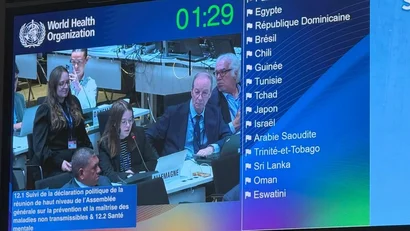
I delivered my statement on the agenda item “Mental Health.” The details can be found in the accompanying policy brief. Originally, the statement was intended for the agenda item “Well-being and health promotion.” Since the agenda at the WHA was changed several times and this agenda item was postponed to Friday afternoon (after my departure), the statement was revised at short notice and assigned to another agenda item with a thematically relevant topic. I was also able to participate in other events, such as a side event co-organized by Germany and a meeting between our Parliamentary State Secretary, Dr. Georg Kippels, and representatives of civil society.
Overall, I found the various insights into the WHA – both in the plenary sessions and outside them, where a sort of parallel WHA takes place for participants not part of the member states’ delegations – to be fascinating.
As part of the youth work, I collaborated with the Swiss youth delegate to develop a concept for a youth delegates’ booth. The goal was to encourage delegations from other member states – particularly those outside Europe, where youth delegate programmes are still relatively uncommon – to establish their own programmes. Together with other youth delegates, we took turns staffing the booth, which was kindly provided to us by the WHO, and through this we engaged in conversations with dozens of delegations. The booth also served as a “home base” for all young people at the WHA. For that reason alone, I hope there will be a similar project next year.
Youth Consultations
A key issue for me at the start of my term was the definition of “youth”: Which associations and groups are actually youth groups, and which are more like networks for early-career professionals? I opted for a definition based on the upper age limit of the group for which the programme is advertised, as well as including young people under 18. In addition, I checked the consultation lists of previous youth delegates for duplicates (e.g., various working groups of the bvmd).
For students and trainees, I developed a programme featuring an introductory overview of the WHO and global health policy, followed by a collaborative effort to define “global health” and identify priorities in selected topic areas (Universal Health Coverage/health systems, One Health/environment, climate & health, NCDs including mental health, AI & research, health security, health equity). The groups were able to choose for themselves which topics they wanted to explore in depth, a format that can be compared in some respects to the Global Health Hub’s “Future Lab.”
As the first youth delegate, I also expanded the consultations to include high school students: this format was piloted in an 8th-grade class at the Hannah-Arendt-Gymnasium in Berlin-Neukölln. After a general introduction to the WHO, multilateralism, and the WHO’s work for young people, the students discussed the topics of the climate crisis, mental health, and equity in small groups. I strongly recommend that future youth delegates continue to pursue this approach – not only to establish legitimacy among German youth, but also because minors are, by nature, scarcely represented in the WHA plenary.
World Health Summit & WHO Regional Committee
For the first time, the youth delegate was given the opportunity to participate in the World Health Summit. I was already familiar with this event from my previous volunteer roles, but I also consider it a great starting point for future youth delegates, both for getting to know the team and for gaining general insights into global health policy and relevant stakeholders.
Through another volunteer role, I also attended the WHO Regional Committee meeting in Copenhagen in October 2025. Even though I wasn’t part of the German delegation, it was incredibly helpful to meet people from the department there and to understand the WHO’s plenary procedures in a smaller, somewhat less stressful setting. In some delegations, it is customary to fully integrate the youth delegate into the RC delegation. In my view, this event is even more relevant to the programme than the WHS. Therefore, I would appreciate it if it could be explored whether regular participation is possible as part of the Youth Delegate Programme.
Thematic Preparations
The visit of the BMG and GIZ in Berlin, which is part of the programme, had to be shortened this year due to an internal relocation at the BMG: one day at the BMG, one day at the GIZ. At BMG, the focus was on drafting the statement and gaining insights into day-to-day work. At GIZ, I gained insights into the areas of work of most team members and participated in a workshop on involving youth in the Global Health Hub Germany. Unfortunately, a last-minute plan to attend a meeting of the German Bundestag’s Health Committee was not possible.
My impression is that the structure of the internship varies quite a bit from year to year, partly due to changing contact persons at the BMG. While a smooth handover at the youth delegate level cannot completely resolve this discrepancy, I would still like to share with my successor which events and opportunities have been available in the past and what can be requested well in advance. The visit at the BMG usually takes place during the peak phase of WHA preparations. By showing a bit more initiative, I hope the youth delegate can also help lighten the BMG contact person’s workload in preparing for the observation period.
Organizational Matters
The application process involved submitting a resume, a letter of motivation, and an essay in English, followed by an interview. The process struck me as standardized and fair. During my term, there were monthly check-in calls with the contact person from Division 624 at the BMG and the contact persons at GIZ. GIZ organized hotel accommodations and travel for the WHS, the visit of BMG and GIZ, and the WHA, taking my availability into account.
Further Development of the Programme
In my view, the programme has three major strengths: its institutionalized connection to the BMG and GIZ; the clear expectation that youth delegates take the initiative to involve young people; and the right to deliver a statement at the WHA.
I would like to raise three additional points here for discussion as opportunities for further developing the programme.
First, I would recommend regular participation in the WHO Regional Committee as part of the Youth Delegate Programme. So far, this is not the case. I was only able to attend the RC meeting in Copenhagen through another volunteer role. It was incredibly helpful to become familiar with the WHO’s plenary procedures in a somewhat smaller, less stressful setting before attending the WHA. In my view, the RC is at least as valuable to the programme as the World Health Summit, if not more so, since it provides an introduction to WHO procedures as direct preparation for the WHA.
Greater involvement in the delegation’s work—for example, through an internship—could significantly deepen participation in the substantive work and at the same time ease the burden on the division; however, this would require the youth delegate to be available for more time, which might not be equally feasible for everyone. Accordingly, I am well aware of the drawbacks of this idea, but I would still be pleased if it were discussed as part of the programme’s future direction.
I would also advocate for considering, during the youth consultations, what specific objectives are being pursued. The participating groups differ greatly in how intensively they engage with global health in their day-to-day work and, consequently, in how easily they can formulate concrete international, rather than primarily national, priorities. One possible approach would be to hold a preliminary introductory workshop on the WHO and global health policy, while the actual consultations—which feed into the policy brief—could be structured more as a series of presentations with expert input followed by a joint process of developing recommendations. Another option would be to explicitly announce the programme with focus topics that change annually.
Acknowledgments
Before I move on to the acknowledgments, I would like to recognize the work of Lisa Biskup, who supported me during the first six months of my term and who, sadly, passed away shortly after her internship at GIZ ended. I still find it hard to come to terms with this – my deepest condolences go out to her family and friends.
A heartfelt thank you goes to Kathrin Rief, my contact at the Federal Ministry of Health, as well as to Katharina Behr, Leonie Kienzle, and Nadja Moser, who managed the Youth Delegate Programme on behalf of GIZ. I would also like to thank the entire team at Global Health Hub Germany, as well as Division 624 and the rest of the German delegation at the WHA, for their kind support and close involvement—in particular, Björn Kümmel and Valentina Voican, also at the WHO RC, as well as Jasper Schmidt and Marianne Therre-Mano.
On behalf of the WHO, I would especially like to thank Dorine van der Wal and Iris Blom for their support of the Youth Booth, and last but not least, all the youth delegates with whom I had the privilege of working at the WHA.
I am very grateful for the opportunities this programme has offered me and for the chance to advocate for the concerns of young people at the international level. I hope that I was able to live up to these expectations and that the experiences and recommendations documented here will help make the programme even more effective for future youth delegates.
Experiences of former youth delegates
Experience Report of Amélie Belosevic (PDF Version)
Ahmet Bekisoglu's Experience Report of 2025
Eva-Lotte Seibold’s Experience Report from 2024
Miriam El-Mahdi’s Experience Report from 2023
Anile Tmava’s Experience Report from 2022
Theresa Krüger’s Experience Report from 2021
We have invited Amélie Belosevic (German youth delegate to the 79th World Health Assembly) to share her personal reflections on her role as a youth delegate with us. The views expressed are her own and do not necessarily reflect the position of Global Health Hub Germany.
Related Articles