Glimpse into the Global Health Policy of the Federal Foreign Office: Interview mit Dr Martin Bergfelder
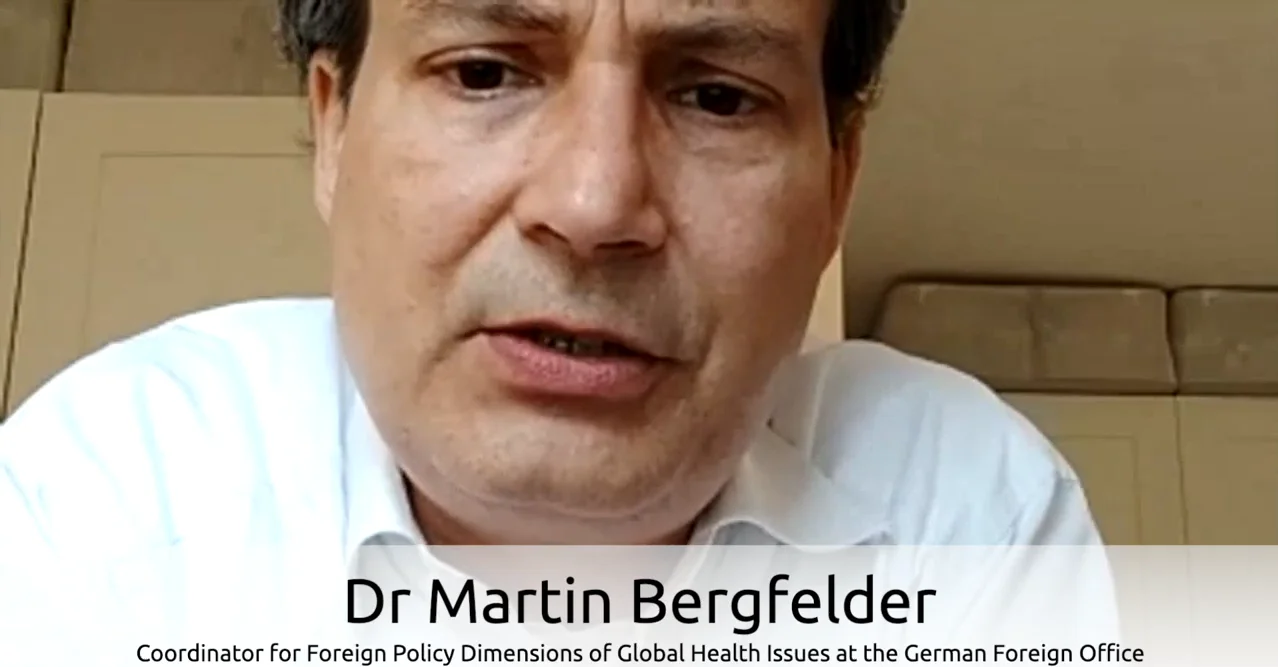
As part of our interview series “The Hub in conversation with...”, members of the parliament and representatives of ministries share insights into their work. For this issue, we interviewed Dr Martin Bergfelder, Coordinator for Foreign Policy Dimensions of Global Health Issues and Head of the Corona Task Force at the German Foreign Office.
Mr Bergfelder, you are a diplomat at the Federal Foreign Office Germany, the Coordinator for the Foreign Policy Dimension of Global Health Issues and Head of the Corona Task Force. What are the main issues the Federal Foreign Office deals with when it comes to Global Health?
Martin Bergfelder: The Federal Foreign Office is mainly in charge of coordinating the positions of the various line ministries in Germany when it comes to Global Health – that's the first part of my title. There are various international processes going on, like G7 and G20. We try to ensure a coherent German approach. Especially at the height of the pandemic we have had coordination meetings almost every day from working level up to Permanent Secretary level. One part which is now more prominent than before is about more long-term orientated policy issues, especially the Pandemic Accord. The COVID Task Force is about coordinating the international response of Germany and the German contribution to the Access to COVID-19 Tools (ACT) Accelerator and Covid-19 Vaccines Global Access (COVAX). It is quite unique to have a collective approach of all ministries deciding what to do, how much money to invest and how to split it across ministries.
The second part of the job is about additional support apart from money and politics. It's mostly about providing vaccines, ventilators, masks and therapeutics for other countries. All of this was not done by the Foreign Office alone, but we played an important coordinating role, including preparing all the internal papers within the German Government and preparing decisions for the cabinet.
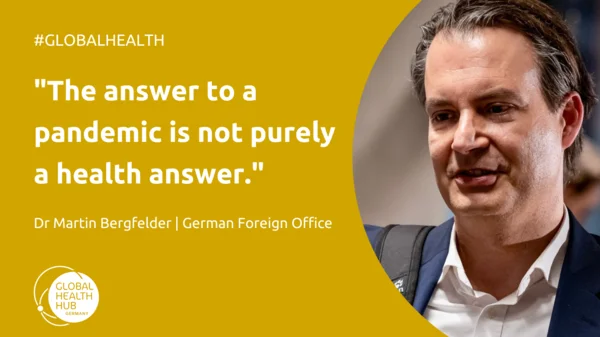
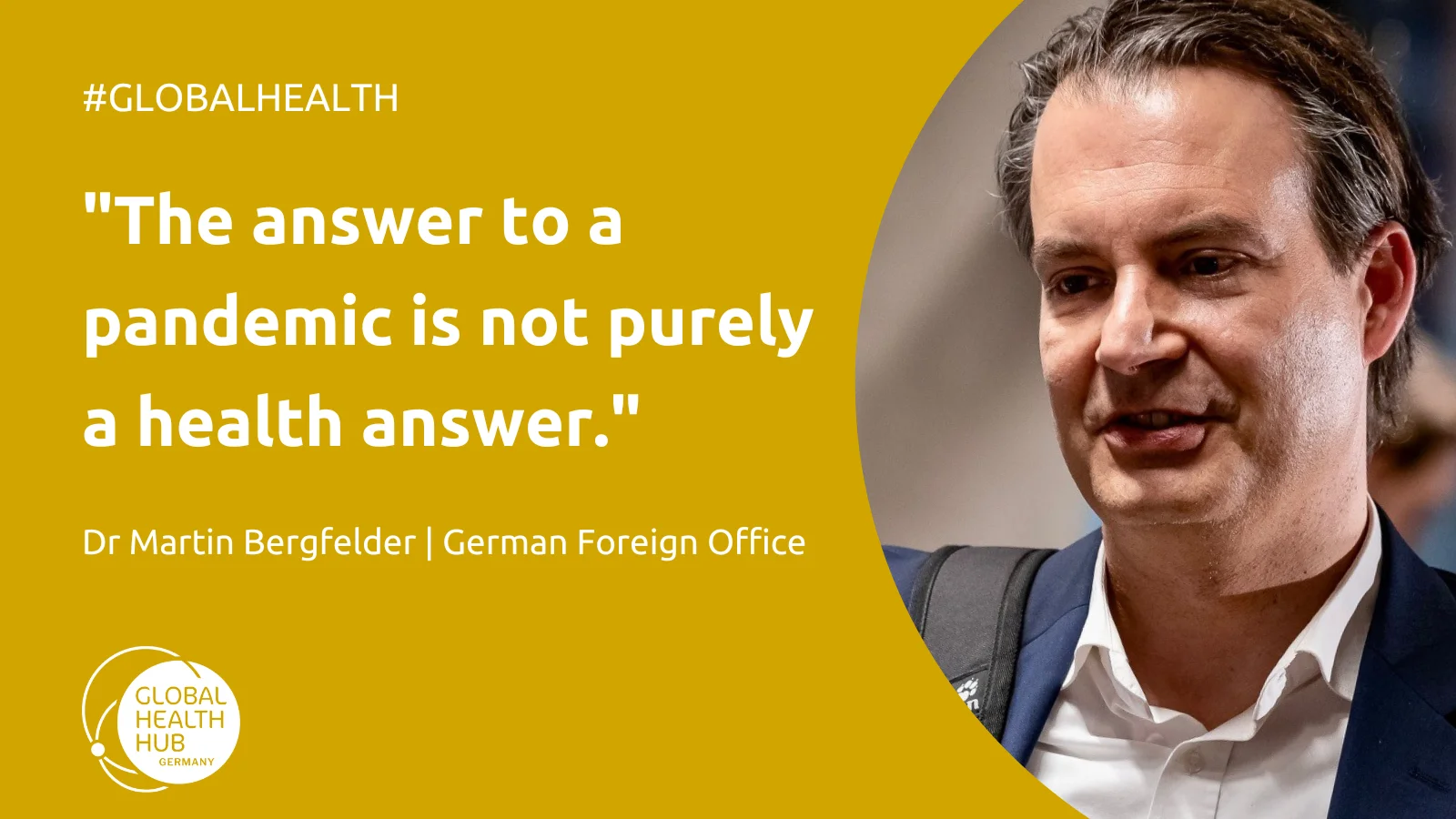
Generally speaking, since the pandemic the Foreign Office is much more involved in Global Health than it has been in the years before. It's too much to say that it is a new topic for the Foreign Office, but it became much more important and much more prominent during the pandemic. We are still putting more resources and more political attention to this even with the pandemic entering a transitional phase now. We are trying to look at the broader perspective, at the geopolitical perspective and to listen to our partners in the Global South, which is linked to a broader foreign policy and geopolitical agenda. There are great expectations in the Global South that we as the international system will come to a better response for the next pandemic. It is our job in the Foreign Office to make sure these voices are heard and to translate them into something tangible that works. We are not the Ministry of Health, we are not the Ministry of Economic Cooperation but we are taking a broader perspective. This is important since we have seen that the pandemic was not purely a health crisis. Health is important, but the answer to a pandemic is not purely a health answer.
One of the goals of the Coordinator for the Foreign Policy Dimension of Global Health Issues is to further strengthen Germany's role in Global Health. What does this entail in particular?
Martin Bergfelder: First of all, this entails making sure that Germany is not just providing financial support but also shaping the agenda and processes. Secondly, it means to raise Global Health issues in international fora to keep it visible. For example, if you look back at our G7 Presidency, the Last Mile Initiative that Germany set up, was developed in the Foreign Office, then in cooperation with the Ministry of Economic Cooperation and others and it transferred into a G7 Foreign Ministers Action Plan, meaning that it was quite prominent in our G7 agenda.
We are also very much engaged in US-led processes on foreign ministers’ involvement. Generally speaking, this is a cross-governmental effort, and we need all governments. In many countries in the Global South, it can have an impact if a foreign minister, instead of a health minister, raises this issue. In the last three years we have experienced that there are channels in these governments that are easier to deal with from a foreign minister's perspective. Our ambassadors were also very involved. We have shared vaccines with more than fifty countries, other medical goods with more than 100 countries and the ambassadors were always present when the staff was transported and spoke with the highest level of the government. We have seen how it can help for other difficult political issues if they are aware that Germany stood by their side in the time of the crisis and that this was a deliberate attempt by the top of the government.
To sum up, there's always a limited amount of topics a minister can raise and the role of my unit is to make sure that the minister takes this topic with her wherever it is useful and necessary.
Another important goal of the Coordination for the Foreign Policy Dimension of Global Health Issues is to improve the linkage between the various actors in the field of international health governance. What measures are you taking to achieve this?
Martin Bergfelder: The good thing is that we are not the only Global Health organisation that the German Government is financing. The Ministry of Health is the main contributor to the WHO. The Ministry of Economic Cooperation is traditionally the one that's funding the GAVI’s and Global Fund’s of this world. That means that we are not bound to one organisation, which helps us to have a broader picture, to make sure that these organisations work together, check who does what best. ACT-A and COVAX were kind of the first approaches in the pandemic and currently we are working on building a successor platform for the next pandemic in order to have an improved mechanism that ensures rapid and equitable access, and all actors can play their role. Again, this is a cross-governmental effort. We will not go anywhere if we don't work together with other ministries.
In the following there are three questions from our Global Health Hub community: The Federal Foreign Office is leading the COP28 negotiations on limiting greenhouse gas emissions. The recent IPCC report shows that decisive global action has so far failed and that we are not recording the emission reductions to achieve our common climate goals. This will have devastating consequences on human health. How will the Foreign Office bring the health impacts of climate change into the debates and negotiations at the next COP?
Martin Bergfelder: We are well aware that there is a linkage between health and climate. At the last COP it was already a part of it, the WHO had its own pavilion there, for example. We are making sure that this is not only happening at the next COP, but already featuring in the Pandemic Accord’ negotiations in the G7 process. It's not that prominent in G20 yet, but it is prominent in G7 and at the United Nations High-Level Meetings that will take place this autumn.
In the last two years we helped setting up all the One Health things. For example, the One Health High-Level Expert Panel (OHHLEP) was very much our baby. Everything regarding One Health has obviously to do with climate change.
Epidemic preparedness is a priority topic in Global Health. Which efforts are being made by the Foreign Office to take advantage of the know-how in German academic institutions to promote a rational approach towards predictions and management of major epidemic outbreaks beyond Covid and Ebola?
Martin Bergfelder: There is a lot that is happening through the Ministry of Health and through the Ministry of Economic Cooperation. The main actor that finances big projects is the Ministry of Economic Cooperation. However, I give you an example where we are involved. There are these top-notch researchers from the University of Stellenbosch who sequenced the Omicron variant and who received the German Africa Prize. Part of our role is to listen and to help them find a way through the German system and to make sure they are properly connected with the German research scene. Apart from that, whenever German companies, like Biontech which is quite active in Africa, need support, we try to be there. Additionally, we are supporters of the World Health Summit.
There was one project regarding pandemic preparedness that I’m very proud of: The training of the COVID-19 sniffer dogs in Rwanda that I started at the beginning of the pandemic. There are these German shepherds from the German army that can sniff COVID and that we brought together with the Rwandan authorities. Now there are several of these dogs active sniffing at the airports in Rwanda. They're much better than the antigen tests and Rwanda is now doing projects with other countries in the region to roll out this effort. We have also done a lot for The Last Mile Initiative. We realised that there was a huge problem in the uptake of the vaccines in the Global South. There are many campaigns and public diplomacy on these issues. We have our regional communication hubs around the world. There's one we recently opened in West Africa and the first thing it did was a huge social media campaign on everything related to Global Health, pandemic preparedness, etc., for which we provided all the material.
The outbreak of the Covid-19 virus unmasked the glaring gaps that exist in the Global Health system. Right now, the coronavirus is partially defeated. However, there is already talk of another pandemic, and whether or not the international community is prepared is a concern in international debates. Given its leading role in the global policy role modeling as seen at the EU and other international responsibilities, what is Germany's take at a worldwide level? Or, how possible is it to translate Germany's EU experience into a global outlook?
Martin Bergfelder: If you look at the European experience to the pandemic, we procured our vaccines together and pooled our knowledge. We try to have a collective European response. What we can see is that other regions in the world are also trying to have a more regional approach. Africa Centers for Disease Control and Prevention (CDC) is the most prominent example, but it's also happening in other fora or in other regions of the world, like the CARICOM, Latin America or Asia. We are very involved in cooperating and strengthening these institutions and aim to have a more decentralised approach next time. During the pandemic we have worked quite closely with Africa CDC. Now is the time to work on the Pandemic Accord, on the shortcomings that COVAX had and to make sure that we come up quickly with the successor to ACT-A and COVAX. We are working hard on this, and the Foreign Office is heavily involved. There are a very bold EU proposals that aim to ensure that next time we are doing better. For example, by ensuring that the industry can also work with these proposals and that especially the Least Developed Countries benefit. My goal is to come up with a better solution and not to waste time. We need to come up with something this year, otherwise it will be difficult to mobilise political momentum in this cycle of panic and neglect. But we will not be able to achieve a fully equitable worldwide answer because the pressure of national interests is so strong. We should be realistic and pragmatic in what we can achieve. This is one of my personal takeaways from this pandemic, from this crisis.
When you look back five years from now, what is it that you would have liked to achieve in your position as Coordinator for the Foreign Policy Dimension of Global Health Issues?
Martin Bergfelder: What I want to have achieved is first of all topic-wise, namely that we will have made a contribution to a better international system for Global Health on prevention, preparedness and response, that the Pandemic Accord will have been ratified. I also hope that we will have managed to keep Global Health as an important topic in the Foreign Ministry. There are always political cycles. We had a huge team in the Ebola crisis, afterwards there was just one person and then in the COVID-19 pandemic I had quite a big team. We will see whether we still have a dedicated Global Health team in the Foreign Office in five years or whether this will have taken the back burner and when the next pandemic hits, we quickly must scale up operations again. Keeping Global Health anchored should be a topic in foreign policy and the Foreign Office should remain a respected player within the government. The other ministries should still want to work with us and appreciate the contribution of the Foreign Office and not just counting the days until the Foreign Office looks elsewhere and forgets about Global Health.
This interview was conducted by Sabrina Rupprecht.
Read further interviews from our series “The Hub in conversation with...”: