Voices from the GHHG Community on the reform of the Global Health Architecture
The Global Health Hub Germany (GHHG) invited its members in a recent survey to share their views on the WHO-hosted, Member State-led Joint Process to reform the current Global Health Architecture. In this article, we present the survey results.
Why a GHHG member survey on the reform process?
In May 2026, the 79th World Health Assembly (WHA) adopted the decision to establish a one-year, WHO-hosted, Member State-led Joint Process to reform the current Global Health Architecture (GHA). The current ecosystem ids complex as well as partially shaped by fragmentation. The reform process therefore pursues three central objectives: 1) Enhancing the alignment of the mandates and capacities of the various GHA actors, 2) Enhancing coordination and decision-making, and 3) The alignment of funding with national, regional and global priorities. [1, 2]
The process is led by a 25-member Joint Task Force set up under the WHA decision [1] and consists of the following members as of November 2026:
Bhutan, Brazil, Burundi, Ethiopia, France, Japan, Kuwait, Malaysia, Mexico, Pakistan, Thailand, United Kingdom of Great Britain and Northern Ireland representing the Member States and their respective WHO world region. Germany and China hold the position of Co-chairs.
CEPI, Gavi, the Global Fund, the Pandemic Fund and Unitaid taking part as global health initiatives.
WHO, UNFPA and UNICEF joining as United Nations entities.
The World Bank.
And Africa CDC, which was chosen as the representation of regional health organizations within this Joint Task Force.
The process is well underway, with an interim report to be expected in November 2026. [2, 3, 4]
To feed the perspectives of the German global health community, especially non-state actors, into this process, the Global Health Hub conducted a survey among its members. The anonymized and aggregated results were shared with the German Federal Ministry of Health (BMG).
“The aim of the process is to be inclusive and draw upon the perspective and expertise of all actors, and non-state actors have an important role to play. We thank the GHHG ´s global health community for providing these important perspectives”, says Co-Chair of the Joint Process, Björn Kümmel.
The process and the voices of the Hub-members
The anonymous survey ran from 16 July to 18 August 2026 and was open to all GHHG members. In total, 69 people responded with 41% of participants coming from academia and research, making this the largest group of respondents. The survey focused on the first reform objective: enhancing the alignment of mandates within the GHA. The other two objectives, coordination and financing, were also briefly addressed.
The survey results
Please note: This article presents the most frequent answers; the full aggregated results are linked at the end of the article.
Role of the WHO
Across the survey, respondents emphasized WHO’s importance in setting norms, standards and technical guidelines and its role as a global convener. They also highlighted its role in generating evidence, in global oversight, monitoring and surveillance as well as in emergency coordination.
Participants were asked which of 13 global health actors (s. table below), they considered as especially suited for contributing to the following functions (up to three choices per function):
Norms, standards and technical guidelines
Data, monitoring and knowledge
Surveillance and health security
Research, development and access to health products
Development cooperation and health system strengthening
Humanitarian health crises and emergency response
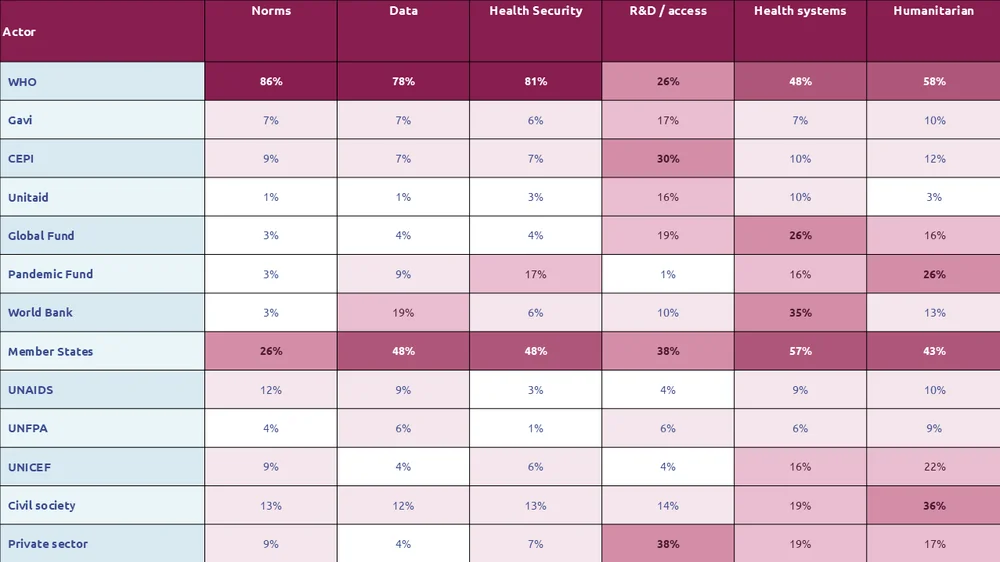
Table: “In your opinion, which actors are especially suited for contributing to the following functions – also in differentiation to other actors?” (n = 69, max. 3 choices per function); Share of respondents choosing this actor as especially suited for each function. Column labels are shortened.)
The respondents considered WHO to be best suited for all queried functions but two. Its lead was clearest for the categories “setting norms, standards and technical guidelines”; “surveillance and health security” as well as “responsibility for data, monitoring and knowledge” (s. table above). For “development cooperation and health system strengthening”, participants saw Member States as best suited. For the remaining functions, consensus was less clear and margins notably smaller. Participants were given the opportunity to elaborate on their choice if they chose multiple actors of the GHA for one particular function. For insights into these results, please refer to the end of this article.
Across responses, one message came through clearly: WHO should not act as a financer, implementing agency or get involved in procurement and development. These responsibilities should fall to other actors of the GHA.
What other actors bring to the table
Asked about the added value of GHA-actors other than WHO, respondents named:
Member States (and national public health institutes): political legitimacy, contextual knowledge and implementation leadership.
World Bank: financing role, closeness to political actors and specialized expertise.
Global Fund: specialized financing capacity (large-scale, longer-term), strong Public-Private-Partnerships and country-level coordination were mentioned.
United Nations entities (UNICEF, UNAIDS and UNFPA) and Gavi: country presence, implementation capacity and focused expertise.
Civil Society: proximity to the people and lived experience as well as holding other actors accountable.
Academia and Private Sector: evidence generation and innovation.
Coordination and decision-making within the GHA and the alignment of funding
To improve coordination across the GHA, participants most often suggested: 1) A clear division of roles, 2) More inter-actor exchange or coordination, as well as 3) Shared data, reporting and metrics structure. In order to better align global health financing with national, regional, and global priorities, the most common suggestions were: 1) Considering country-led or bottom-up priorities in financing, 2) Better coordination among donors, actors and priorities, as well as 3) More transparency in the financing processes.
Stakeholder involvement
Most participants suggested including stakeholder groups‘ expertise into the GHA reform process. Many called for a meaningful inclusion from the beginning and throughout the process, some suggesting formalized involvement. Suggestions on how this inclusion could be designed included regular exchanges on the reform process or advisory roles. Respondents also asked for transparency within the process, especially on how expert inputs are taken into account, as well as for the reform to be evidence-based. Further ideas can be found in the results overview at the end of the article.
Recommendations to the German Federal Government
Respondents were invited to address suggestions directly to the German Federal Government. The following suggestions emerged:
The German Federal Government should …
participate actively in the GHA reform process, both politically and financially
promote a reform process that meaningfully includes diverse voices such as LMICs and different stakeholders, for example civil society or the private sector
support the WHO, especially by securing its continued financing
advocate for a clear distribution of responsibilities and a reform of financing mechanisms
back the reform with transparency and with monitoring and evaluation of the process
(Only suggestions made by at least three respondents are listed here.)
As overarching goals for the reform, respondents named equitable participation, access and balance of power, clear roles and responsibilities, as well as a financing reform. In addition, leadership at country, regional or community level should be a key aim. Transparency and accountability emerged as key themes across the survey.
Disclaimer:
A detailed overview of the aggregated results can be accessed here.
Sources
Related Articles