
From Fragmentation to Fit-for-Purpose: New Evidence for Global Health Reform
How can multilateral health organisations work together more effectively in a future health architecture? Comparative Advantage in the Multilateral Health Ecosystem Insight series – a new analysis from the Multilateral Performance Network (MOPAN) – examines the mandates, strengths and incentives shaping global health cooperation, and identifies priorities for reform.
The demands placed on the global health system are evolving faster than the architecture designed to address them. Development assistance for health is projected to fall by 19–33% from 2023 levels, and geopolitical shifts are changing which priorities are funded and how. In most countries, domestic resources are carrying more of the cost. Regional institutions are taking on functions once held globally. Non-communicable diseases, mental health and ageing now account for a growing share of need. Policymakers are urgently exploring how to make the global health architecture fit for future purpose in this context. And the task is as much a political one as a technical one.
Building on its assessments of multilateral organisations’ performance, the Multilateral Performance Network (MOPAN) brings new evidence to today’s reform discussions through three complementary cross-organisation studies of nine major multilateral organisations: the World Health Organization (WHO), World Bank, United Nations Children's Fund (UNICEF), United Nations Population Fund (UNFPA), Gavi, the Vaccine Alliance (Gavi), the Global Fund to Fight AIDS, Tuberculosis and Malaria (Global Fund), the Global Financing Facility (GFF), the Pandemic Fund and Unitaid.
Together, the three studies examine the extent to which today’s global health architecture is aligned with future priority health functions [1], where comparative advantage lies across organisations, and what reforms could make the system more effective for countries.
The global health architecture was never designed as a system
MOPAN’s first study - Mapping of Organisational Mandates Against Future Priority Health Functions - shows that the current configuration of mandates, across the nine multilateral organisations, is ‘not yet' fit to deliver the six functions that a reformed global health architecture will need.
Both mandate expansion and a lack of collaboration and alignment among organisations especially at the country level have created overlap - and likely inefficiencies. The current global health architecture was not designed as a cohesive system, and no mechanism exists to assess its combined system-wide effects. Instead, organisations have individually accumulated mandates, financing arrangements, and operational roles over decades.
The study concludes that while mandate rationalisation is necessary, greater emphasis must be placed on understanding and reforming the underlying financing, accountability, and governance arrangements, and the incentives underpinning them, that currently drive mandate evolution and expansion. The organising framework for the future architecture should place rationalisation, collaboration, and comparative advantage at its core.
MOPAN’s second study – Comparative Advantage Analysis - asks where comparative advantage lies across the nine organisations. The analysis confirms that organisations bring distinct strengths that reflect their mandates, legitimacy, financing models and institutional design. Collectively, the organisations cover much of what priority global health functions require. For example, WHO brings normative authority and standard-setting functions, while financing institutions provide resources at scale. Organisations such as UNICEF contribute operational and delivery expertise.
However, comparative advantage is not being optimised.
The overall picture is one of uneven configuration, slow adaptation to future needs and limited connectivity between capabilities across organisations and across global, regional and country levels. As a result, comparative advantage is not maximised, countries bear much of the cost, and a coherent approach to equity and fragile and conflict affected settings is missing.
Implications for reform
For decision-makers seeking to build a more coherent and effective global health architecture, four implications emerge from the findings:
Centre the future global health architecture around countries. External support for country health systems is not a coherent offer and can substitute for national systems; countries spend scarce capability managing separate external processes.
Shift financing incentives and behaviours of external partners. Financing rewards results that organisations and funders can attribute to themselves, often over short cycles and around externally-driven priorities; and each funder times transition from its support on its own terms.
Govern the global health system as a whole and adapt it as needs change. No organisation can steward the system as a whole or direct its independently governed peers; and roles, mandates and financing have not been designed collectively or adapted coherently to meet changes in future burden of disease and climate-related health risk.
Deliver and finance global functions and global public goods fairly and predictably. Norms and standards, prequalification, data and alerts are paid for by a few donors, cycle by cycle and mostly earmarked.
From evidence to action
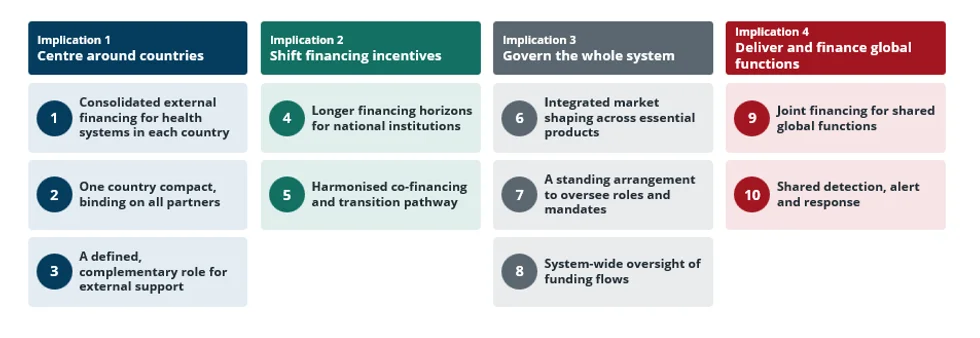
MOPAN’s final, third study – Reform Pathways - translates these findings into ten ‘Reform Objectives’ designed to strengthen how organisations work together.
Two principles apply to every reform:
1: Build on comparative advantage, so that each organisation concentrates on what its mandate and design equip it to do and steps back where others are better placed; and
2: Protect what cannot readily be rebuilt, such as global standards, prequalification, emergency authority and global health data.
Some reforms can be implemented quickly through clearer responsibilities, stronger coordination and more coherent positions across governing boards. Others would require more fundamental changes to financing and governance arrangements.
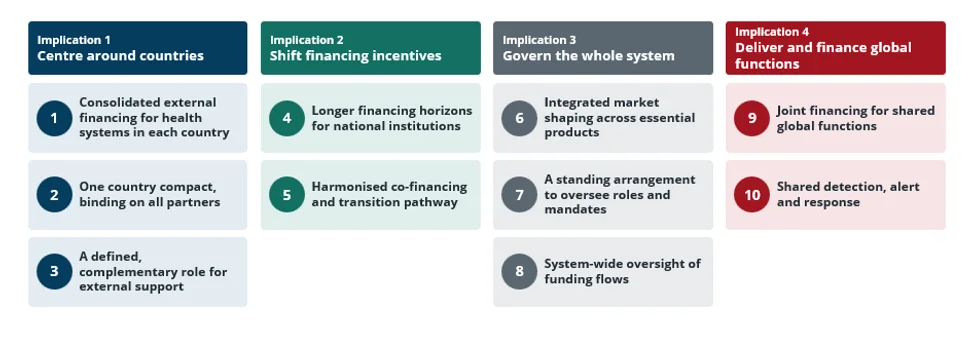
MOPAN’s Ten Reform Objectives
Reform design will require trade-offs, particularly when considering the impact on equity; fragile and conflict-affected settings; the changing burden of disease; and subsidiarity. As external financing declines, support will need to be tailored to countries’ income levels, capacities and vulnerabilities, with low-income and fragile contexts likely to require the greatest assistance. Reform is possible across multiple fronts; the choices about pace, ambition and risk rest with decision-makers.
Using this evidence, decision-makers considering global health architecture reform have an opportunity to set a vision for a coherent ecosystem, that plays to organisational comparative advantage, supporting countries to better plan, buy and pay for their own health priorities, with fairer access for the people most in need, and ensure the sustainable and equitable financing of the functions every country relies on.
About MOPAN: Established in 2002, the Multilateral Performance Network (MOPAN) is an independent network of 20 member countries that pool their expertise and resources to assess and improve the performance of multilateral organisations.
Through independent assessments and analysis, MOPAN provides trusted evidence that helps members manage risks, inform decision-making and support organisational improvement. In doing so, MOPAN promotes accountability, learning and trust across the multilateral system. Find out more: www.mopan.org | LinkedIn
Notes
[1] The six functions are: 1. Setting norms and standards; 2. Strengthening country health systems; 3: Developing and delivering health products; 4: Tracking population health, detecting and raising the alarm on health threats; 5: Responding to emergencies; and 6: Stewardship: coordinating the global health system and holding it accountable.
Related Articles