Maternal and child survival at a pivotal moment
Child deaths fell for decades. Now progress is at risk. Why maternal and child survival must stay central to Global Health and Germany’s leadership today.
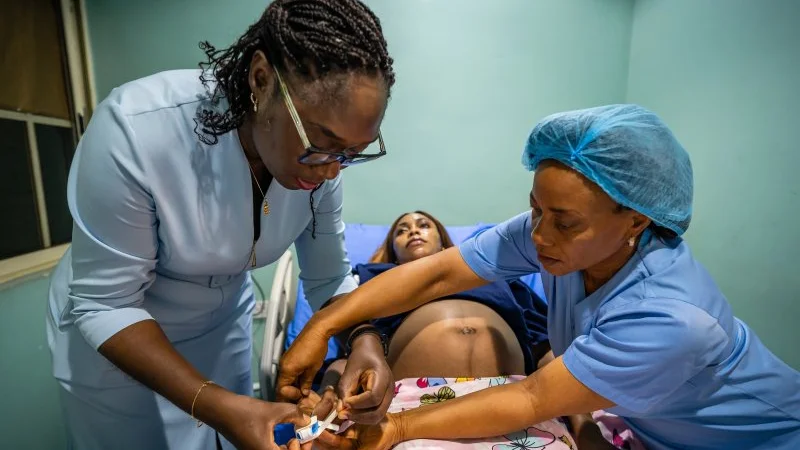
About the cover image: Opeyemi Akinajo, Consultant in Obstetrics and Gynecology, Lagos University Teaching Hospital, LUTH (left) and Echendu Chinyere, Deputy Director Nursing Services, LUTH (right), fit a limb sensor on a pregnant patient, Kemi Abiloye's (center), on her right finger during a demonstration of the ANNE maternity sensor, an AI-powered device for real-time monitoring of fetal vitals and contractions at the hospital's labor ward in Lagos State, Nigeria on June 4, 2025. ©Gates Archive/Light Oriye
Maternal and child survival is at a pivotal moment
As a physician working in rural India, I have often cared for women whose pregnancies turned critical far too quickly, simply because care came too late or not at all. I have seen how the absence of a trained midwife, basic equipment, or timely referral can turn a routine birth into a life-threatening emergency. Many of these situations have become less common over the past two decades, but they have not disappeared, and that progress is now at risk of reversing.
At the start of this century, nearly 10 million children died each year before their fifth birthday. Close to half a million women died annually from complications related to pregnancy and childbirth, most from causes we know how to prevent.
In the decades since, the world has made remarkable progress. Child mortality has been cut in half. Maternal deaths have dropped by roughly 40 percent. These gains were not accidental. They were the result of sustained investment in simple, proven interventions and a shared commitment to act.
But that progress is no longer guaranteed.
What progress has taught us
We now know what works. Survival improves when basic, affordable care consistently reaches those who need it most: timely antenatal care, skilled midwives at birth, emergency obstetric services when complications arise, reliable immunization programs, family planning, and targeted nutrition support during pregnancy and early childhood.
Together, these interventions have saved millions of lives and reduced newborn deaths by more than half since 1990.
Just as importantly, they have strengthened entire health systems. What began as donor-funded programs in the form of official development assistance or initiatives by foundations in many countries has evolved into nationally led infrastructure. Community health workers, vaccination programs, family planning programs, and maternal care services are increasingly built into government budgets and policies demonstrating increasing country leadership and political commitment.
The warning signs we cannot ignore
That progress is now under threat. For the first time in decades, child deaths are projected to rise.
Conflict is disrupting access to care. Climate change is increasing the risk of preterm birth and pregnancy complications. Malnutrition, often invisible, contributes to nearly half of all child deaths and one in five maternal deaths.
These pressures are converging at a time when global attention is shifting and funding is under strain. What had been steady, hard-won gains are beginning to stall and, in some places, reverse.
This is a pivotal moment. We cannot afford to lose momentum.
Germany’s role, in particular, is critical. As one of the world’s largest partners to low- and middle-income countries, German development cooperation has been instrumental in driving progress over the past two decades. What it does next will help determine whether maternal and child mortality continues to decline or begins to climb again.
Sustained funding for global health institutions such as Gavi the Vaccine Alliance, the Global Fund to Fight AIDS, Tuberculosis and Malaria, and the Global Financing Facility for Women, Children and Adolescents is essential. These investments keep supply chains functioning, ensure access to lifesaving medicines and family planning commodities, and support health workers on the front lines, whether in rural clinics or temporary facilities with minimal equipment. They also play a crucial role in strengthening data systems and thereby improving evidence-based decision-making. When that support weakens, the consequences are immediate on the health of women and children, with medium- and long-term consequences for the strength and resilience of health systems.
At the same time, partners such as the Gates Foundation are reinforcing this effort. Building on decades of work in maternal, newborn, and child health as well as family planning, the Foundation is doubling down on the goal of ending preventable deaths by 2045. This means scaling proven interventions such as primary health care, immunization, family planning, maternal nutrition, quality antenatal care, and skilled birth attendance, while continuing to invest in understanding gaps in science, and in developing innovative solutions to accelerate progress. At a moment when global attention risks shifting elsewhere, this kind of long-term commitment helps anchor progress.
Germany’s contribution to a shared agenda
Germany already plays a central role in shaping global health outcomes, through both financing and political leadership.
German institutions are helping define the next generation of solutions. From advances in neonatal care to improved treatments for pregnancy complications, many of the tools that will shape the future of maternal and child health are already emerging from its research ecosystem. This combination of scientific excellence and practical application is a distinct strength.
But research alone is not enough. Its impact depends on whether these innovations reach those who need them most.
At the same time, Germany’s development policy is evolving. As the Federal Ministry for Economic Cooperation and Development sharpens its focus even more on measurable impact and prioritization, difficult choices will need to be made.
Maternal and child health must remain a clear priority within this process. Not only because it saves lives, but because it underpins broader goals of stability, equity, and economic development.
At a time when some donors are stepping back, Germany has the opportunity, and the responsibility, to hold the line. Its leadership, financial and political, can sustain progress and send a powerful signal globally. Without it, the consequences will not be abstract. They will be measured in lives lost.
Scaling what works, advancing what is possible
Some of the most effective lifesaving tools are already within reach and remarkably simple. Availability of and access to a range of contraceptive options helps women plan pregnancies. A low-cost drape can help detect postpartum hemorrhage early. A daily micronutrient supplement can prevent anemia and reduce the risk of premature or underweight births.
These are not complex breakthroughs. They are practical solutions that save lives when delivered consistently.
At the same time, innovation is expanding what is possible. Portable, AI-enabled ultrasounds are allowing frontline providers to identify high-risk pregnancies in remote settings. New formulations of lung surfactant are making it easier to treat premature babies outside advanced hospital environments.
Emerging research on the maternal microbiome is opening new pathways to address conditions such as anemia, preeclampsia, and preterm birth, with potential relevance far beyond maternal health alone.
The challenge now is not discovery. It is delivery at scale.
A moment for renewed confidence
Maternal and child survival sits at the heart of the Sustainable Development Goals and at the intersection of equity, economic stability, and global resilience. When mothers survive, children are more likely to thrive. Families are stronger. Communities are more stable. To give you a sense of this impact, a single US Dollar can have a return of $16 when invested in midwives, $26 when invested in family planning, and $61 in basic emergency obstetric and newborn care.
The past 25 years have proven that large-scale change is possible. What comes next will depend on sustained focus, reliable financing, national leadership, and continued innovation.
Germany, working alongside partner countries, researchers, and civil society, has a critical role to play in keeping maternal and child survival at the forefront of the Global Health agenda.
Ending preventable maternal and child deaths is within reach. But only if we refuse to accept preventable loss as inevitable.
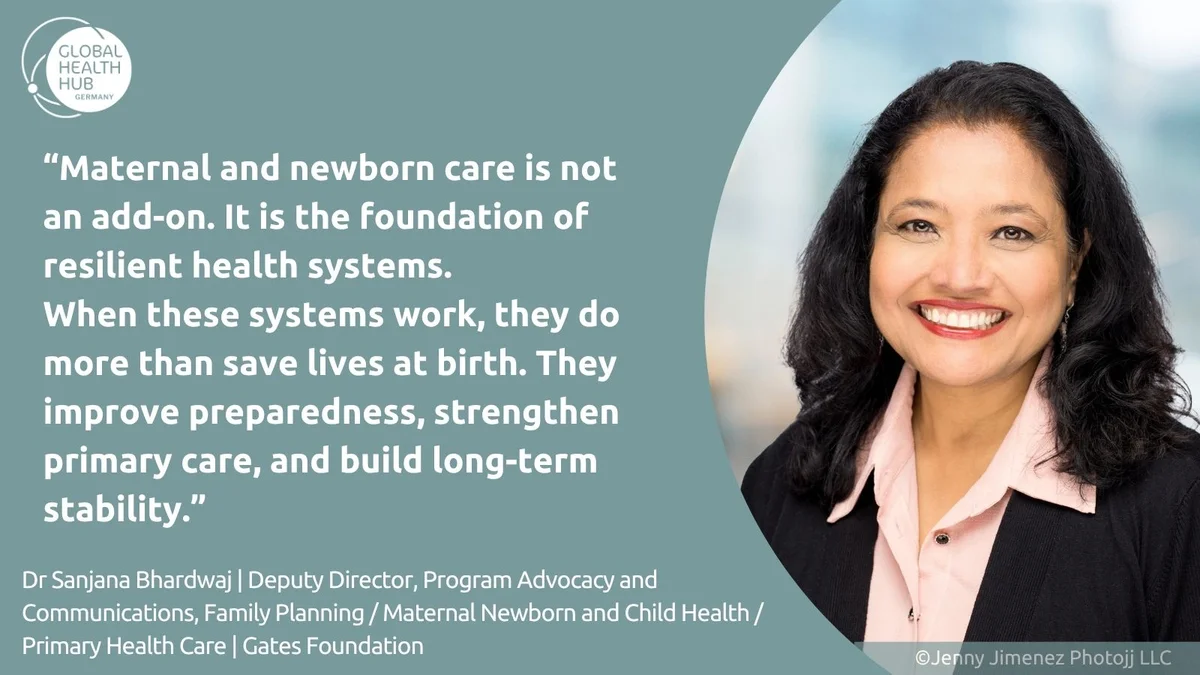
We invited Dr. Sanjana Bhardwaj (Deputy Director, Program Advocacy and Communications, Family Planning / Maternal, Newborn, and Child Health / Primary Health Care) from the Gates Foundation to share her assessment of the state of maternal and newborn health in global health. The views expressed are her own and do not necessarily reflect the positions of the Global Health Hub Germany.
Related Articles