Bundibugyo Ebolavirus disease outbreak exposes shortcomings in Global Health Priority Setting
The recent Bundibugyo virus disease outbreak in the Democratic Republic of Congo (DRC) reveals a new nightmare for communities who have already been struggling with decades of conflict, marked by severe violence against civilians, massive displacement, and lack of access to services, particularly health care.
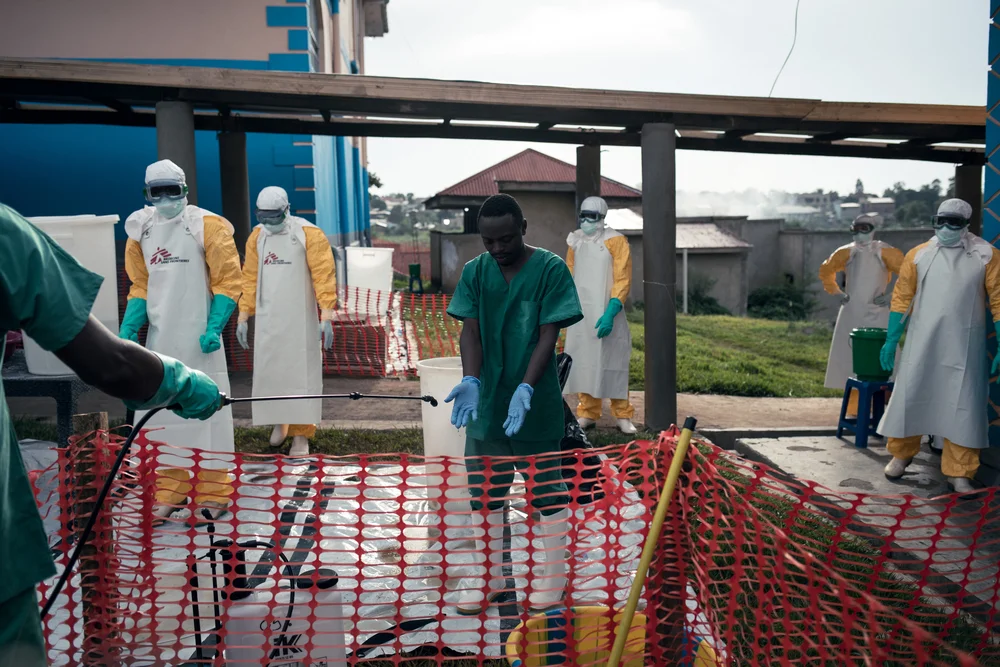
Featured on the cover picture: At the Centre Hospitalier Elikya in Bunia/Ituro, Doctors Without Borders has set up an Ebola treatment center. The facility can treat up to 70 patients. Medical staff remove their extensive protective gear after a shift—under close supervision and using disinfectant.
While local and regional communities have vast expertise in public health response to address Ebola virus outbreaks, the lack of a vaccine, efficient and speedy testing and approved therapeutics for this virus, have enabled numbers to rise undetected and left little remedies. The outbreak occurs in an area with an already weakened health system, infrastructure, and lack of humanitarian access. The latter as well as insufficient presence of other humanitarian actors have led to DRC to be our largest country programme over the past years. Our annual budget in DRC exceeds the individual humanitarian spending of many wealthy government donors and now again, we are mobilizing and implementing a large-scale response, with our medical and logistics teams working around the clock in collaboration with the Congolese health authorities. The crisis requires an immediate and wide-scale response that places the needs of health care workers and patients front and center.
An Outbreak Amid Conflict and Humanitarian Crisis
Disbelief, shock and the immediate question given the lack of a vaccine, rapid point-of-care diagnostic tests and specific therapeutics: Are we back to 2014 when a devastating virus disease epidemic in West Africa killed thousands? The current spread of the Bundibugyo virus in the DRC leaves no time for wondering and inaction.
According to WHO, of 27 May, a total of 906 suspected cases and 223 deaths among suspected cases have been reported in the DRC. As of 29 May, a total of 134 confirmed cases, including nine in Uganda, with 18 deaths among the confirmed cases, have been reported across both countries.
The Bundibugyo virus disease outbreak puts pressure on an already weak primary and secondary health care system in the DRC. Just a few weeks before the discovery of the Ebola disease outbreak, MSF had warned of a healthcare crisis in Minova, South Kivu, calling on donors to reconsider their financial withdrawal from South Kivu, and on authorities and parties to the conflict to guarantee humanitarian access.
The impact of the conflict, including decades of violence against civilians such as sexual violence, and massive displacement, has left millions without safe shelter, medical care, and food. Border and airport closures have cut off vital supplies needed, especially with continued high epidemic risks for diseases such as cholera, measles, and malnutrition. For the current Bundibugyo virus disease outbreak, where speed is decisive, these constraints mean a continued delay in the arrival of critical medical supplies, humanitarian aid, and specialised personnel. We know from experience that these measures severely hinder outbreak response, and isolate countries that urgently need international support.
Containing the Outbreak, Protecting Essential Care
MSF is now mobilizing and implementing a large-scale response. We are running Ebola Treatment Centres across affected areas in Ituri and North Kivu, while additional treatment capacity is being established in South Kivu. Beyond that we are providing trainings on triage, isolation, testing, and referral pathways. Across DRC we are currently employing 2,880 Congolese staff, support 4,633 national health workers, and 323 international medical staff and are deploying teams to affected areas. To protect medical personnel, MSF is sending tens of thousands of personal protective equipment (PPE) kits, containing essential items such as gloves, masks, goggles, gowns, and protective boots. Additionally, we are also establishing an Ebola training centre in Nairobi, in coordination with our Kenya office.
While the outbreak requires a swift and coordinated response, our teams are responding to multiple public health emergencies simultaneously. In parts of North and South Kivu, including areas around Goma, cholera continues to make more people sick than the Ebola disease.
If previous epidemics taught us anything, there is a critical need to ensure continuation of essential health care to avoid a rise in mortality and morbidity. This should include routine vaccinations, maternal and newborn health care, sexual and reproductive health care, nutrition services, infectious disease care, and trauma care. Comprehensive care for survivors of sexual violence must also continue: In 2024 alone, nearly 40,000 women were treated by MSF teams in North Kivu province — a record high. We know that in crises like epidemics, the risk of sexual and gender-based violence rises disproportionately, hence it is critical to take preventative measures and end impunity.
For patients with the Ebola disease, timely treatment and information should be available. Health actors should also strengthen triage systems and patient flow management across all health facilities while preventing routine healthcare structures from becoming overwhelmed.
Beyond Emergency Response: Addressing the Structural Gaps Exposed by the Outbreak
Looking more closely at the response, a central question arises: Why do no vaccines, rapid diagnostic tests, or specific treatments exist for the Bundibugyo virus, despite the fact that this virus has been known since 2007 and that scientific advantages accelerated after previous outbreaks of Ebola disease?
This gap is emblematic of a global health priority‑setting that too often places commercial interests above public health needs. Research on Bundibugyo‑specific vaccines and treatments remains largely at the animal‑testing stage, roughly where research for the Ebola virus (former Zaire ebolavirus) stood when that type caused the massive outbreak in West-Africa in 2014. The reason is clear: developing products for prevention and treatment of the Ebola disease is not seen as a profitable business case.
Even where progress has been made, access remains deeply problematic. Effective treatments for the more common Ebola virus only reached the market in 2019, following the devastating 2014–2016 West Africa outbreak. While their approval marked a major scientific breakthrough, ensuring access for people who need them, has stalled. Governments such as the United States have established national emergency stockpiles that now contain nearly all available Ebola Virus disease (EVD) treatments. As a result, these medicines are largely held as biosecurity tools, rather than being available as lifesaving public health tools in countries where the Ebola disease is endemic. Years after the approval of these treatments the recommended medicines are still far from being used to their full potential in outbreak response. As new clinical trials are now being planned to identify effective vaccines and treatments for the Bundibugyo virus, fair access for affected populations, who also contribute to the development, must be considered from the very beginning — not as an afterthought.
Furthermore, testing capacity remains incredibly limited, which is why the virus has been able to spread so rapidly. Hundreds of tests of suspect cases are waiting to be analyzed. Without test results, it is very challenging to have adequate contact tracing, case management, and community acceptance and trust. Strengthening surveillance systems and diagnostic capacities sharing is therefore critical. Health authorities, donors, international and regional platforms, and operational responders should urgently scale up and decentralise access to Bundibugyo-specific diagnostic capacity.
Dr Alan Gonzalez, MSF’s deputy director of operations recently stated “The response cannot succeed if it is imposed on communities rather than built with them. Every aspect of the response must be rooted in continuous engagement and cooperation with communities — listening to concerns, addressing fear and misinformation, and building trust so that people feel safe seeking care.” These words ring truer than ever and should remind us: A collaborative and coordinated approach that serves the needs of patients and health care workers, is critical to end this pandemic and avoid further suffering.
We call on the German government, who laudably played a critical role in mobilizing support in the 2014-2016 Ebola virus disease crisis, including through medical evacuations and logistical support, to urgently heed this call.
We asked Jasmin Behrends and Stephanie Johanssen from Doctors Without Borders / Médecins Sans Frontières to share their views on the current Ebola outbreak and the necessary measures with us. The views expressed are their own and do not necessarily reflect those of Global Health Hub Germany.
Related Articles
![[Translate to English:] Dr. Solomon Owusu Sekyere (rechts unten) führt die Schulungsteilnehmenden durch einen Test zur Überprüfung der Wirksamkeit von Impfstoffen. Praktische Schulungen bei der Gastbehörde bieten den Partnern eine wertvolle Vorlage für die Umsetzung.](/fileadmin/_processed_/0/a/csm_240301_VaccRelease_Training_ELISA__56__b5b7ce011c.webp)