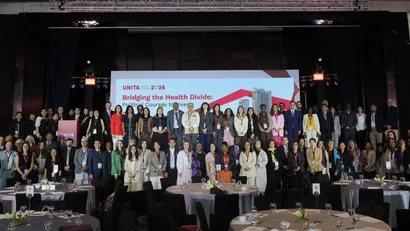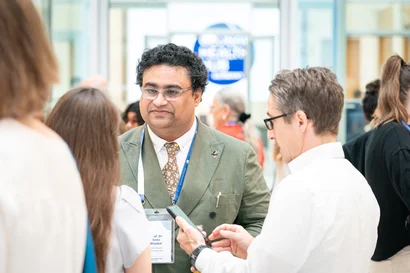
2026 UN High-Level Meeting on HIV/AIDS: Setting the Political Course for Global HIV Efforts
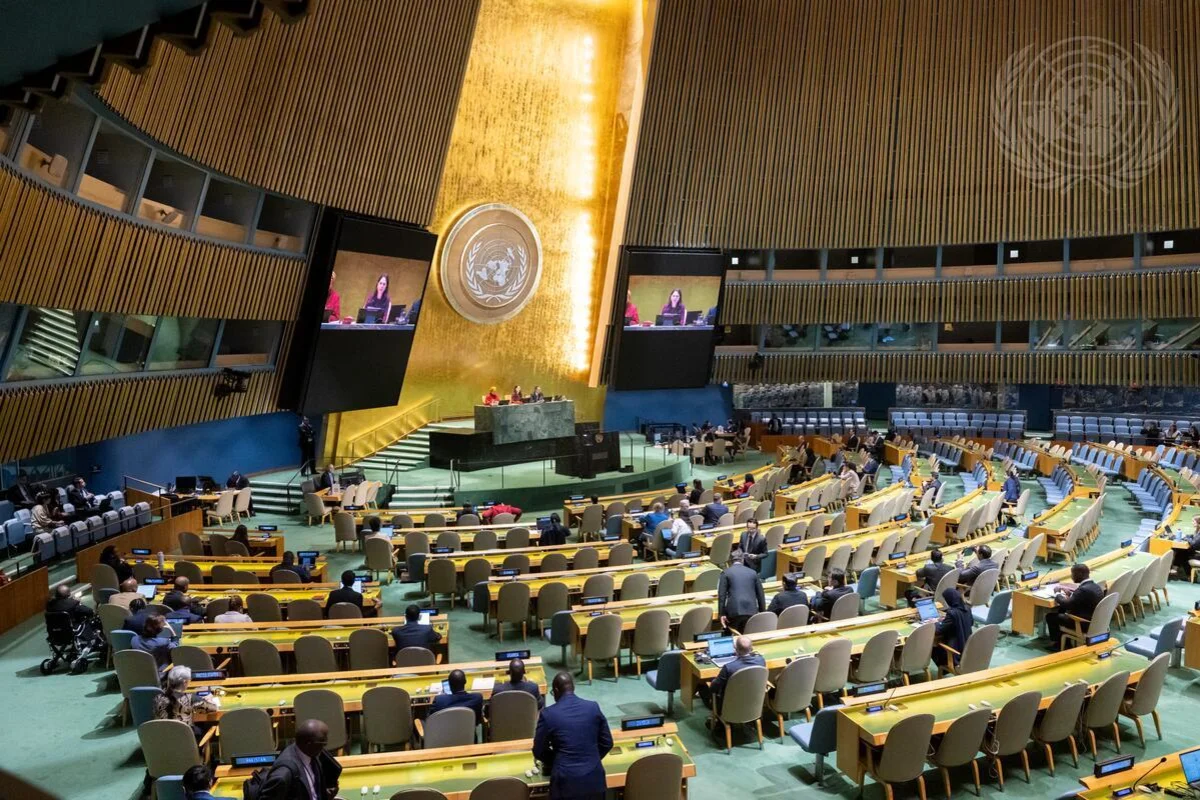
The UN High-Level Meeting on HIV/AIDS (UNHLM), held on June 22 and 23, 2026, in New York, was far more than just a regular high-level United Nations meeting.
Picture 1/Cover image: Annalena Baerbock, President of the 80th session of the United Nations General Assembly, opens the UN High-Level Meeting on HIV/AIDS. Source: UN Photo/Manuel Elías.
Twenty-five years after the historic UN Special Session on HIV/AIDS, the international community faced the question of whether it would consistently continue the path toward ending AIDS as a public health threat by 2030, or whether political polarisation, funding gaps, and the dismantling of multilateral structures would jeopardize the progress made so far.
As a member of the international HIV community, I was involved in the civil society preparatory process for the political declaration and participated in the UNHLM as a member of the German delegation for Action against AIDS Germany. The following report summarises the key discussions, points of contention, and outcomes of the meeting.
Between Progress and Pressure for Reform
The meeting focused not only on future global HIV policy but also on the debate regarding the future of the Joint United Nations Program on HIV/AIDS (UNAIDS). As part of the UN80 reform process, there was even speculation at times about the program’s possible phase-out.
Now, the talk is more often of transformation and transition. The central question, however, remains: How can UNAIDS’s unique strengths be preserved? From the perspective of Action Against AIDS Germany, reform must not lead to the dismantling of proven structures. UNAIDS’s independent coordinating role, its political accountability to member states, and the institutionalised participation of civil society and communities particularly affected by HIV remain indispensable.
Successes Cannot Be Taken for Granted
The importance of these structures is demonstrated by the UNAIDS report United to End AIDS, published shortly before the UNHLM. Since 2010, AIDS-related deaths worldwide have declined by 56 percent, and the number of new infections has fallen by 43 percent. Today, 32.1 million people are receiving antiretroviral therapy.
This progress is not based solely on medical innovations, but on human rights-based policies that have consistently involved affected communities.
Picture 2: Impact of current funding cuts on global HIV efforts: Declines in HIV testing, PrEP, and prevention services between 2024 and 2025. Graphic: Aktionsbündnis gegen AIDS; Data: UNAIDS, United to End AIDS, 2026.
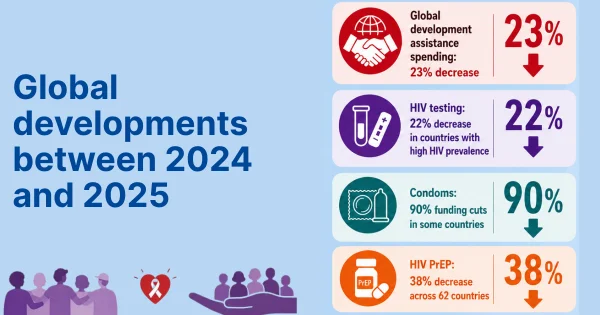
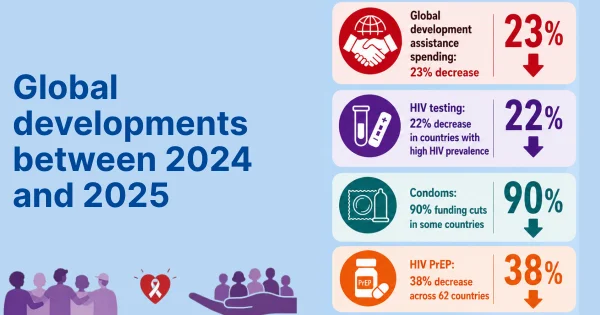
At the same time, this success story is under considerable pressure. Global development cooperation declined by 23 percent in 2025—the sharpest decline ever recorded. In many countries, HIV testing, prevention services, and pre-exposure prophylaxis (PrEP) programs have been scaled back. At the same time, the criminalisation of key populations is on the rise again, creating more hurdles for access to health services. This increases the risk that progress already made will be lost.
Controversial Negotiations
Against this backdrop, the political declaration took on particular significance. The negotiations were exceptionally contentious. The focus was on identifying key populations particularly affected by HIV, human rights and gender equality, the Sustainable Development Goals (SDGs), and the role of civil society.
The main lines of conflict were already becoming apparent during the 81st plenary session of the General Assembly in April 2026.
Among other things, Russia proposed replacing the term “key populations” with more general phrasing such as “vulnerable groups” or “nationally defined population groups.” One reason for this is the criminal prosecution of LGBTIQ+ individuals and people who use drugs. Explicitly naming these groups would highlight the need for action within Russia itself.
Civil Society Representation “al gusto”?
Another point of contention was civil society participation. Russia advocated for stricter, state-controlled accreditation procedures that would have allowed individual states to exclude critical nongovernmental organizations from participation. This would have further restricted the scope of action for independent organisations – yet another example of the “shrinking spaces” for civil society engagement observed worldwide. Both proposals were rejected by the member states.
Gender-inclusive language, sexual and reproductive rights, and the Sustainable Development Goals also sparked intense debates. The United States, in particular, called for the removal of relevant references, thereby once again calling into question multilateral approaches and global solidarity.
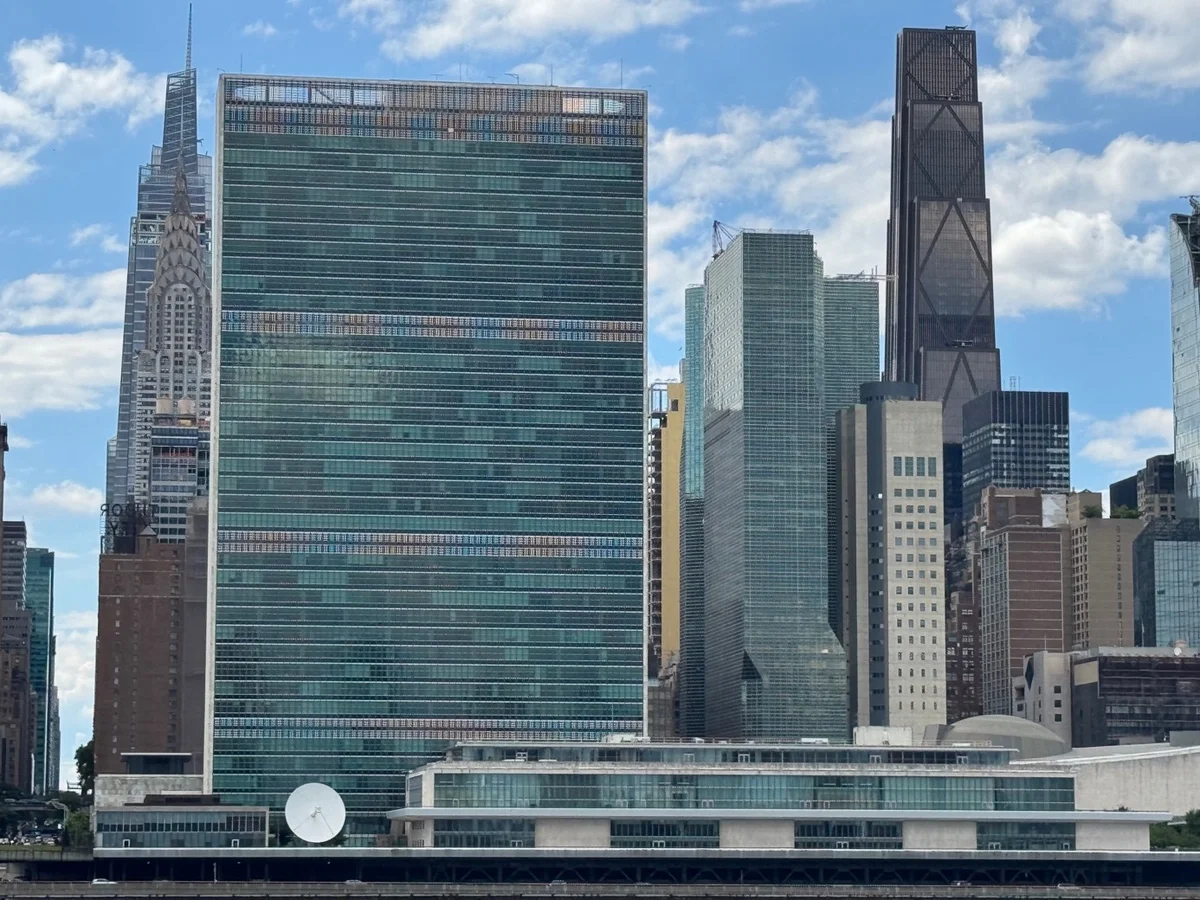
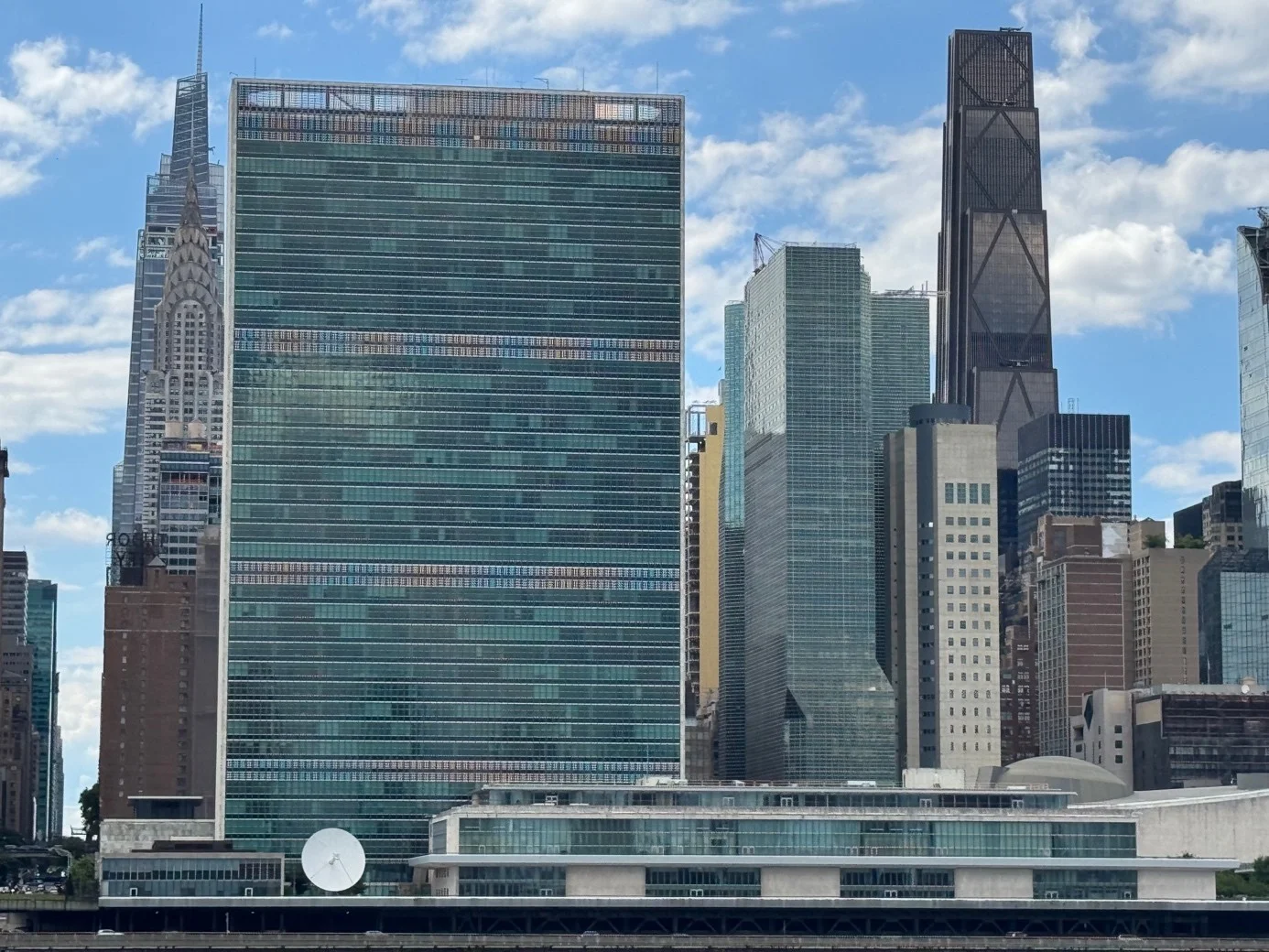
Picture 3: United Nations building in New York. Source: Peter Wiessner
The Role of Civil Society
Action against AIDS Germany became involved in the preparatory process at an early stage. Together with 15 other representatives of international civil society, we were selected to help shape the global consultation process on the political declaration.
Together with partner organisations, we submitted a request to the Federal Ministry of Health to establish a German delegation that included representatives from civil society. The fact that this request was granted sent an important signal – also at the international level. Germany made clear that civil society participation is a central component of its global health policy.
In discussions with delegations and international networks, we advocated for ensuring that community participation, the human rights-based approach, the Sustainable Development Goals, and the identification of key populations remain integral parts of the political declaration.
This effort was successful. Despite considerable political pressure, key elements of the previous global HIV strategy were preserved. The adopted declaration reaffirms the importance of civil society, human rights, the Sustainable Development Goals, and key populations. At the same time, the negotiations made it clear how strongly multilateral processes are now shaped by geopolitical conflicts.
The German federal government also sent an important message in New York. It explicitly emphasized that the successes achieved so far in the fight against HIV would not have been possible without the leadership of civil society. Parliamentary State Secretary and head of the German delegation, Dr Georg Kippels, stated:
“For Germany, close cooperation and sincere dialogue with civil society have long been a central component of the HIV response. This approach was first championed by former Federal Minister of Health Prof. Rita Süssmuth. And it has proven successful (…).”
An important signal, but not a sure thing
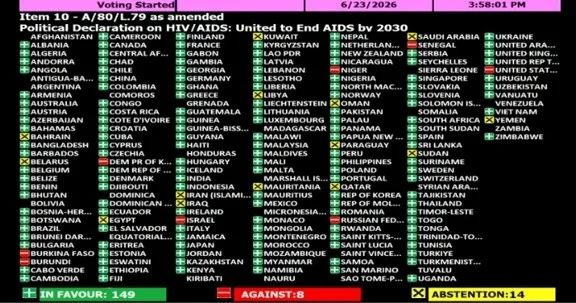
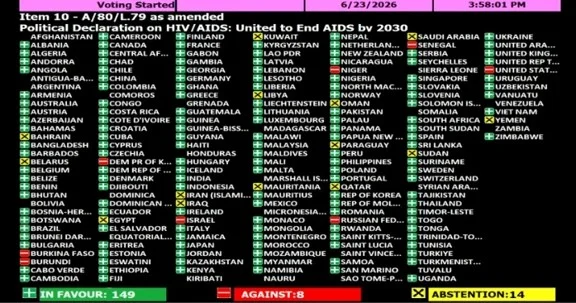
After intensive negotiations, the member states adopted the political declaration with 149 votes in favour, eight against, and 14 abstentions. Among those voting against were Russia, North Korea, the U.S., and Israel.
Picture 4: Voting results on the resolution of the UN High-Level Meeting on HIV/AIDS. Source: Peter Wiessner
The adoption of the declaration sends an important political signal. However, what is decisive is whether the commitments made are implemented and what role UNAIDS will play within the United Nations system in the future.
True transformation must not mean dismantling proven structures or weakening community participation. Rather, it is essential to strengthen the very functions that have made UNAIDS successful: independent coordination of the global HIV response, political accountability, evidence-based policy, and the mandatory involvement of civil society.
As an expression of this commitment, more than 500 organisations – including Action against AIDS Germany, Deutsche Aidshilfe, and the Deutsche Stiftung Weltbevölkerung – published a joint “People’s Declaration” at the conclusion of the meeting. In it, they call for permanently secured funding for global HIV efforts, the protection of human rights, and the binding involvement of communities.
Conclusion
The 2026 UNHLM made two things clear: The international community remains fundamentally committed to the goal of ending AIDS as a public health threat by 2030. At the same time, the political, financial, and institutional conditions necessary to achieve this are by no means a given.
That is precisely why a strong and independent civil society remains indispensable. Action against AIDS Germany will continue to actively support this process and work to ensure that the voices of people living with HIV and the communities most affected continue to be heard in the future.
We invited Peter Wiessner from Action Against AIDS Germany to share and contextualize the key takeaways of the UNHLM on HIV/AIDS with us. The views he expresses are his own and do not necessarily reflect those of the Global Health Hub Germany.
Related Articles