Advancing men’s health in Germany and globally: Improving health for all
Men’s health is a global public health issue, linked to women’s wellbeing. A national strategy in Germany to tackle men’s preventable death can improve outcomes for all and reduce societal costs.
A focus on men’s health has typically been perceived as taking attention away from women’s health. It is essential for the global health community that we move beyond this zero-sum framing. Addressing men’s health and women’s health is not a binary choice; these concerns are inextricably linked. Men’s ill-health is a public health issue – it not only impacts on men themselves, but costs societies billions of USD annually (World Health Organization (WHO), 2025) and negatively impacts on others, particularly women. Crucially, for those of us deeply concerned about the global push back on women’s health and rights, speaking to men’s own gendered health needs, and ensuing both men and women feel heard and valued, is also key in challenging the perception that women’s progress is men’s loss.
So what’s going on with men’s health? Globally men are dying on average five years earlier than women. A key cause of this premature mortality is men’s greater likelihood of death due to non-communicable disease (NCD) risk factors – particularly cardiovascular disease, certain cancers, and suicide. These poor health outcomes in men are not an inevitable biological reality. They are preventable through shifting individual behaviours and traditional masculine norms that discourse health-seeking and can lead to late diagnosis and avoidable complications, as well as improving health services and strengthening policies. These challenges around men’s life expectancy gap, disease burden, and poor health-seeking are also evident in Germany.
Momentum is building for a stronger global focus on men’s health. The WHO’s 2018 European Region Strategy on the Health and Well-Being of Men intended to guide all member states, including Germany, toward addressing male health through tailored policies and gender-responsive action. Whilst requisite national action across Europe has been limited, last year England approved its first-ever Men’s Health Strategy (the only G7 country so far to do so). Ireland, which has had a men’s health strategy since 2008, is showing steady improvements in the health of its male population. Global Action on Men’s Health (GAMH) held the first-ever roundtable on men’s health at the 2025 World Health Summit (WHS). Europe’s Beating Cancer Plan includes several commitments on preventing male cancer, and Europe is a success story in expanding human papillomavirus (HPV) vaccination to both boys and girls, preventing significant HPV-associated disease morbidity and mortality. An increasing number of countries are now discussing developing a national men’s health strategy, with Canada the most recent to announce its intention to do so.
In Germany, men’s health is not a new issue. In 2021 a German Manifesto for Men’s Health was published by several leading organisations including the Federal Forum for Men (Bundesforum Männer), the Foundation of Men’s Health (Stiftung Männergesundheit), and the Boys’ and Men’s Health Network, and was accompanied by submissions on men’s health to the Bundestag. These actions sought to ignite a national debate on the necessity to focus on men’s health in Germany as part of a broader gender-health strategy to improve outcomes for men and society as a whole. Discussions on this have since stalled, however several organisations have continued to undertake research and work on men’s health in Germany, such as Stiftung Männergesundheit (see box below).
Since 2010 the Foundation for Men’s Health (Stiftung Männergesundheit) in Germany has published six major men’s health reports covering topics such as mental health, sexuality, retirement, and violence. It has also published over 40 patient guides on men’s health, including on depression, prostate cancer, nutrition, physical activity, bladder cancer, work-life balance, and the transition to retirement. The Foundation undertakes public awareness activities, particularly during International Men’s Health Week, which in 2026 will focus on the theme “Loneliness is a risk – togetherness is a resource.” It has also established the Advisory Board of Men’s Sheds in Germany, together with practitioners and academia, to strengthen social connection and well-being among men. Despite these substantial contributions, the Foundation faces significant challenges, including a lack of state funding, limited staffing, and insufficient political uptake of existing research.
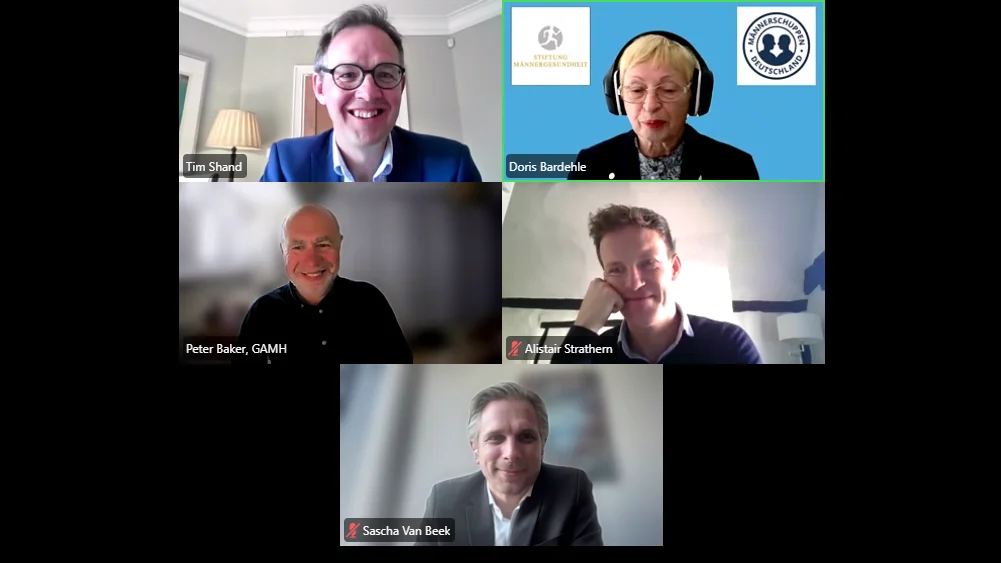
To revive these developments, and build on the current momentum, GHHG in partnership with GAMH organised a global webinar on 23rd April 2026 on advancing men’s health and the benefits of doing so for everyone (recording available on YouTube here). Sascha van Beek MdB, Member of German Bundestag and spokesperson for Men’s Health, came together with Alistair Strathern MP, Member of UK Parliament and Co-chair of the Labour MP Men & Boys Group, alongside Corinna Heineke and Leonie Kienzle from GHHG, Peter Baker and myself from GAMH and Doris Bardehle from the German Men’s Health Foundation. This interactive event reaffirmed the need for a Men’s Health Strategy in Germany and to renewing political engagement and collaboration to make this a reality. It explored the epidemiological indicators of men’s poor health internationally and in Germany, and how investing in men’s health can reduce preventable mortality, improve quality of life for all, and lower long-term healthcare costs. It discussed the current policy context around men’s health, key barriers and policy gaps (particularly around mental health and prostate cancer), existing community-based initiatives and advocacy on men’s health, and opportunities in Germany, across Europe and globally to strengthen a focus on this issue. It also raised the possibility to integrate an action plan on men’s health into the new national gender equality strategy in Germany, and how the German government - with its proud feminist history - is well positioned to advance these discussions in Europe and more globally.
In the webinar, Sascha van Beek, MdB, said:
“I am delighted to be holding this important conversation about improving men’s health in Germany. Given its history of commitment to women’s health and rights, the German government can play a key role in advancing a broader gender-responsive approach to healthcare and is well positioned to advance this discussion both within Germany, in Europe and internationally. We can provide new momentum to earlier initiatives and research in Germany. Ultimately, investing in men’s health strengthens families, communities and economic productivity.”
What comes next? GAMH is keen to build on this impetus at the GHHG Summit in July and the World Health Summit in October, both taking place in Berlin. In 2027, we will produce a Real Face of Men’s Health in Europe report in partnership with Movember, and build a European coalition on men’s health. We are also exploring funding partners for a dedicated national men’s health report in Germany, informed by new commissioned health economic analysis. Please keep in touch with us at www.gamh.org and sign-up to receive our newsletter here.
We invited Dr Tim Shand, Policy Consultant at Global Action on Men’s Health, to share his insights on why advancing men's health in Germany and globally could improve health for all, drawing on insights of the shared webinar with the Global Health Hub Germany that took place April 23, 2026. The views expressed are his own and do not necessarily reflect those of the Global Health Hub Germany.
Related Articles