
Key messages from our latest Catalyst Dialogue on Health Security
Germany must link health and security in both policy and practice. This is the conclusion of our new Catalyst Dialogue.
Germany must link health and security in both policy and practice. This is the conclusion of our new Catalyst Dialogue.
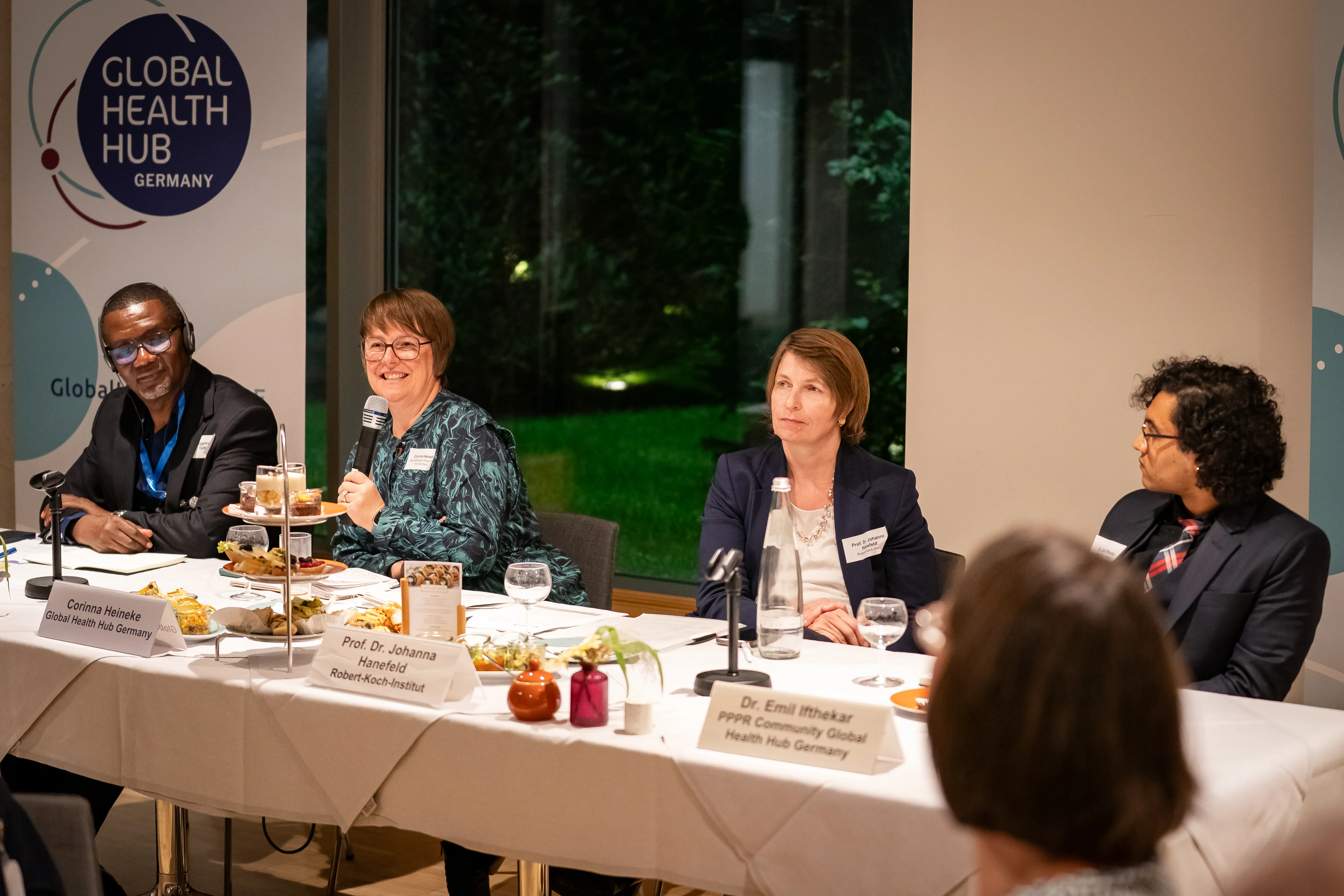
Health security is a political choice. This is the central message of the GHHG’s new Catalyst Dialogue on health security which was launched and discussed at a Parliamentary Evening with members of the Bundestag, ministries and health security experts from diverse stakeholder groups. Two Catalyst Dialogue participants, Aggrey Aluso of the Resilience Action Network Africa (RANA) and Prof. Dr Johanna Hanefeld of the Robert Koch Institute (RKI) contributed reflections from the health security debate. Dr Emil Iftekhar, the co-manager of the GHHG community on pandemic prevention und biosecurity, provided additional perspectives by sharing insights from the latest community paper on Priorities for the 2026 UN High-Level Meeting on Pandemic Prevention, Preparedness, and Response. The Parliamentary event concluded with broad agreement that Germany does not need to – and cannot – choose between health and security, or between national resilience and global health. The evening’s and the Catalyst Dialogue’s central proposition is that these agendas can and must reinforce one another, without allowing either to dominate.
Catalyst Dialogue on Health Security
Factsheet Catalyst Dialogue on Health Security
Why a Catalyst Dialogue on health security?
Recent developments have exposed the fragility of people’s safety and well-being worldwide, including in Germany: the global COVID-19 pandemic pushed health systems and economies to the brink of collapse. Conflict and climate-related shocks continue to affect lives, livelihoods and socio-political stability. These multidimensional threats transcend national borders and sector portfolios.
This reality explains why “health security” has moved to the centre of attention among experts. To help inform German policy makers, the GHHG convened a high-level “Catalyst Dialogue”, the sixth in the series since 2022. Through individual interviews and a virtual debate, the format brought together three international experts from the non-state sector – from academia and civil society, including from the Global South – as well as two German experts from a federal agency and the defence sector to complement the international insights with insider views on processes and policy in the German context.
Catalyst Dialogue participants
International experts:
- Aggrey Aluso, Executive Director, Resilience Action Network Africa (RANA), Kenya.
- Dr David Heymann, Professor of Infectious Disease Epidemiology, London School of Hygiene and Tropical Medicine; former chair of the UK Health Protection Agency; former WHO Assistant Director-General for Health Security and Environment, Geneva, Switzerland.
- Carmel Williams, Director, Centre for Health in All Policies Research Translation, School of Public Health, University of Adelaide, Australia.
German experts:
- Dr Johanna Hanefeld, Professor and Acting Vice-President of the Robert Koch Institute, Germany.
- Dr Hans-Ulrich Holtherm, Major General, commandant of the Bundeswehr Medical Academy, Germany.
The views expressed in the Catalyst Dialogue and this article reflect the breadth of the discussion and do not necessarily represent a consensus among all five participants.
Interconnected threats require a cross-sectoral response
The experts identified three broad categories of concern: pandemics and major disease outbreaks; military, hybrid and biological threats; and climate change and extreme weather.
These threats rarely occur independently and can exacerbate public health weaknesses. Ineffective surveillance can delay the detection of an outbreak; overstretched services may be unable to absorb a surge in patients; conflict can weaken disease control; and transport or supply-chain failures can interrupt care. The experts therefore call for a “polycrisis” perspective that acknowledges the linkages between health and security and addresses systemic vulnerabilities rather than preparing separately for individual hazards.
“Health and security are linked, whether you want it or not, because of various security angles, ranging from bioterrorism to infectious diseases.”
— Johanna Hanefeld
The deliberate misuse of biotechnology illustrates the direct connection between public health and national security. Responding to bioterrorism requires many of the same capabilities needed to control naturally occurring outbreaks, including surveillance, laboratories, logistics and emergency-response capacity. Investments justified on security grounds can therefore strengthen the health system as well.
“Health is an essential part of our critical infrastructure. Critical infrastructure and security are closely connected. It’s not only power lines or cyber security. Health is inseparably linked to security.”
— Hans-Ulrich Holtherm
Institutional and political barriers to cross-sectoral collaboration
While health security threats cut across institutional boundaries, the experts noted that ministries have few incentives to invest time and resources in objectives that fall partly outside their formal mandates. Moreover, Germany’s disjointed administrative structures – siloed ministerial portfolios and performance agreements – can discourage cross-sectoral collaboration, making inter-ministerial work appear as an unrewarding additional burden.
Some Dialogue participants noted that the Federal Ministry of Health also lacks the institutional influence of traditional “power ministries” such as finance, interior, defence and foreign affairs, partly because public and global health are not sufficiently recognised for what they contribute to national security. This makes it difficult for the health sector to convene more powerful ministries or sustain cross-government action once the immediate pressure of a crisis subsides.
Short political horizons compound the problem. Cooperation often intensifies during emergencies but declines afterwards as task forces dissolve, personnel move on and lessons are forgotten. Preventive investments are politically difficult because their greatest successes are largely invisible: a crisis that does not happen attracts less attention than a newly built hospital or a dramatic emergency response.
“Political leaders are looking for immediate gains with re-election in mind. The public health community is thinking of long-term gains, which often don’t satisfy the needs of politicians.”
— David Heymann
The paper therefore argues that health leaders must change how they approach other sectors. Rather than asking what another ministry can contribute to health, they should demonstrate how health capabilities can help that ministry fulfil its own mandate. Defence benefits from preparedness for biological threats, agriculture from controlling zoonotic risks, finance from preventing economic disruption and foreign affairs from building trusted international partnerships.
How can health security be anchored as a cross-sectoral agenda item in Germany?
The policy brief recommends nine concrete steps that German decision makers can take to establish health security as a cross-sectoral task.
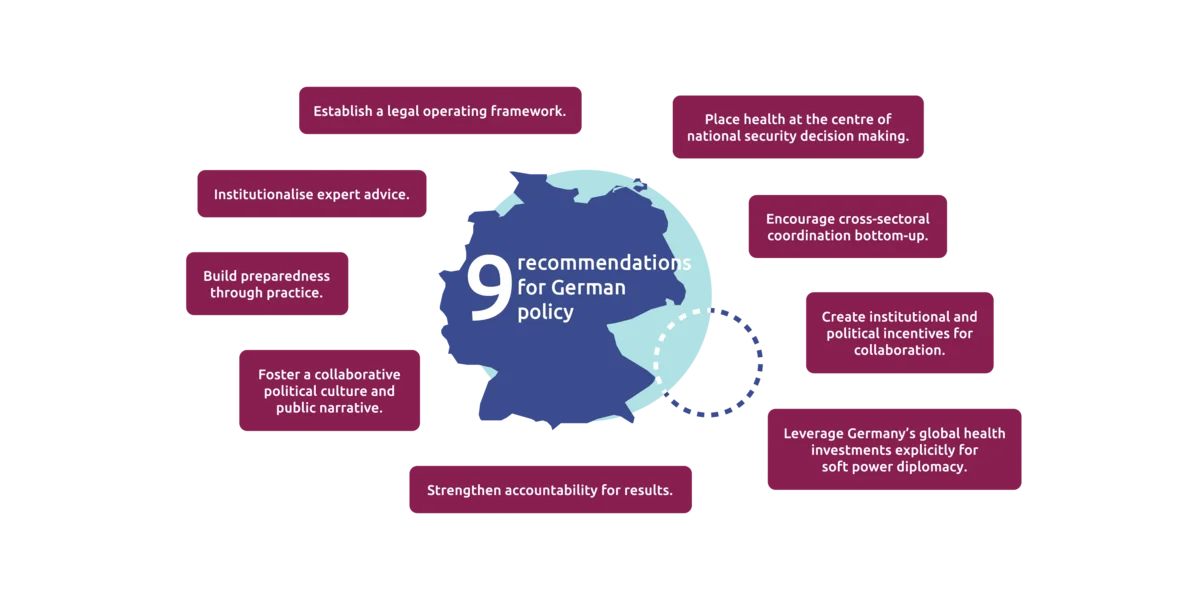
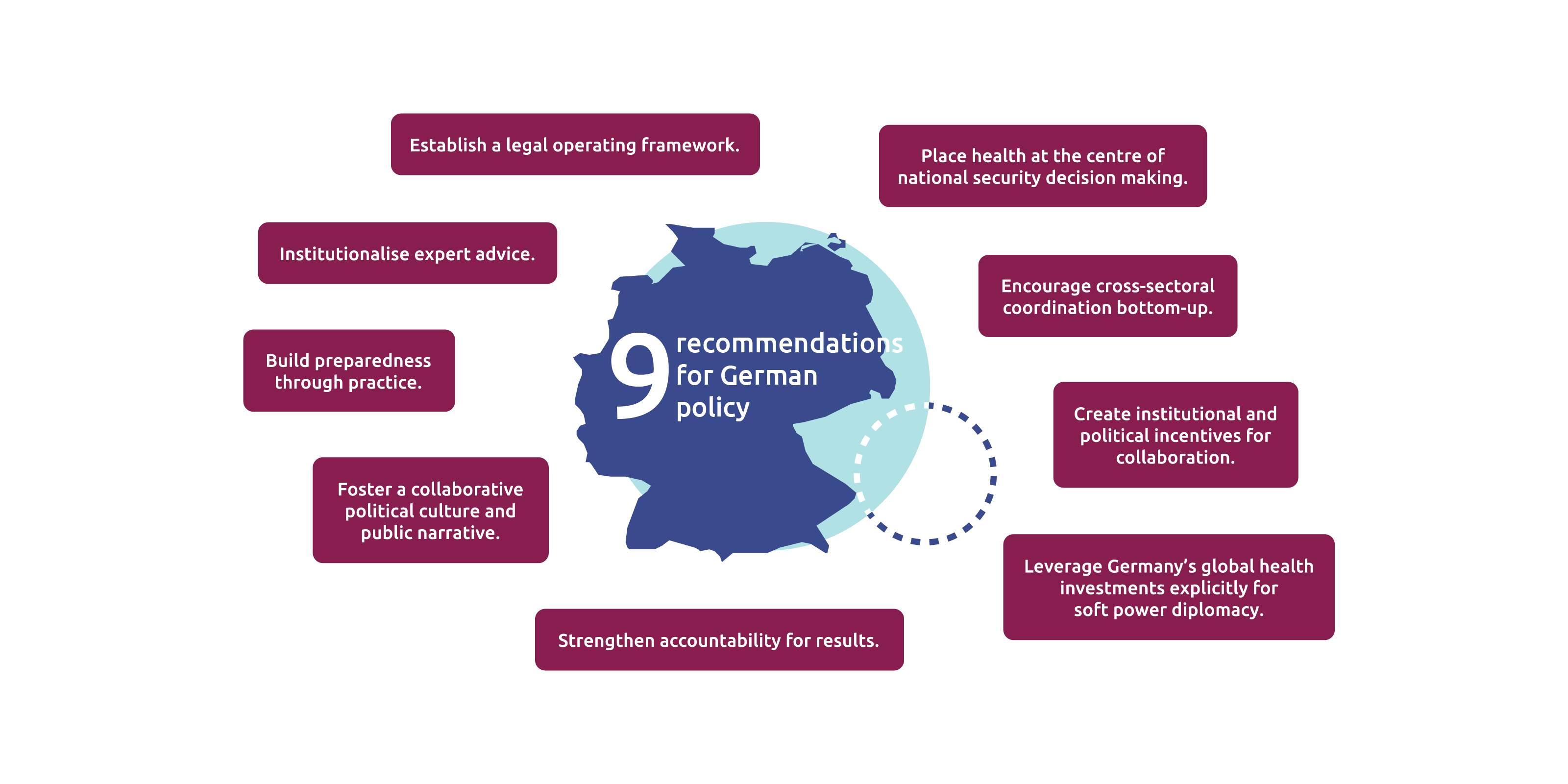
One of the paper’s central proposals is to advance Germany’s stalled Gesundheitssicherstellungsgesetz (Health Security Assurance Act) as the foundation for pursuing health security. The experts also recommended anchoring political leadership at the centre of government by giving the Federal Ministry of Health a permanent seat on Germany’s National Security Council and locating overarching health security governance in the Federal Chancellery, where interministerial conflicts can be resolved and momentum maintained between crises.
Alongside an established legal framework and political leadership, Catalyst Dialogue participants proposed initiating and nurturing cross-sectoral collaboration from the bottom up through networks of technical staff that can begin working together informally on shared tasks such as horizon scanning and risk assessment. This cooperation would build trust, demonstrate practical value and make institutional boundaries more permeable without eliminating necessary areas of specialist responsibility.
“Intersectoral action is really about relationships and collaboration. It is about building trust. It is about sharing power. We don’t want the silos to break – we need them – but we want the silos to be more permeable.”
— Carmel Williams
Regular simulations are another priority to build preparedness through practice and to raise awareness for the often invisible value of health security. This is particularly effective when exercises involve political leaders, ministries, public health agencies, hospitals, laboratories, emergency services, the armed forces, civil protection, businesses and civil society.
“It really takes a lot of narrative building and getting people to appreciate the return on investment when we are able to maintain our health security by preventing outbreaks from spiralling out of control. We can stimulate that political incentive through the people.”
— Aggrey Aluso
Finally, the Catalyst Dialogue participants rejected the notion that national health security can be pursued separately from global health. As pathogens, vectors and antimicrobial resistance do not respect borders, Germany cannot secure its own population without functioning public health systems both abroad and at home. Therefore, the experts argued that Germany should continue taking a leading role in global health and to leverage the country’s investments in this area explicitly for “soft power” diplomacy.
All recommendations from the Catalyst Dialogue are elaborated in more detail in the paper on health security.
Note:
This Catalyst Dialogue is an initiative of the Global Health Hub Germany and was funded by the Wellcome Trust. The views expressed in this publication are solely those of the Catalyst Dialogue participants and do not necessarily reflect those of the Global Health Hub Germany Secretariat or the Wellcome Trust.
