Hub @ 7: Past, Present and Future
Seven years of connecting voices and shaping global health debates. The Hub reflects on progress made and its future role in Germany’s global health landscape.
Seven years ago, the Global Health Hub Germany launched with the aim of bringing together diverse national perspectives to strengthen global health engagement in Germany. Since then, the Hub has grown into a key platform connecting civil society, academia, think tanks, youth, politics, international organisations, foundations, and the private sector. On the occasion of the Hub’s 7th anniversary, managing director Corinna Heineke reflects on crucial milestones, lessons learned, and the vision for the years ahead.
How has the global health landscape changed since the Hub was founded, and how has the Hub adapted to new challenges and priorities?
The Hub was founded at a time at which the German Federal Government prioritised its investments in global health through several large investments, bilateral health programmes, and through new formats in global health, for example in the context of the G20. From the highest level, then Chancellor Dr. Angela Merkel endorsed the Global Action Plan for Healthy Lives and Well-being for All (SDG3 GAP) under which 13 multilateral health, development and humanitarian agencies came together to strengthen collaboration and accelerate progress on the health-related Sustainable Development Goals (SDGs).
In the context of geopolitical shifts and conflicts, as well as the partly resulting budgetary constraints at national level, global health has slipped from political attention despite the amazing impact the field has had on life expectancy and other health indicators worldwide. However, it is not only money that is waning but also support for fundamental premises of global health cooperation: a trust in science; sharing of data; multilateralism making us stronger together.
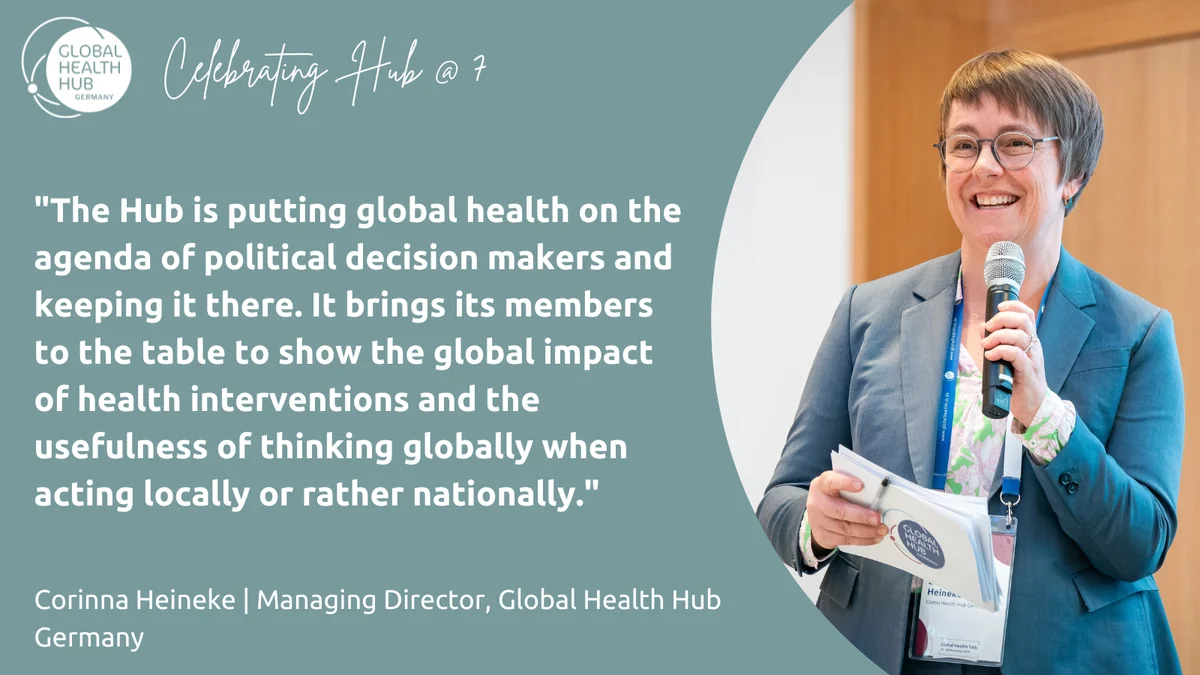
The Hub is putting global health on the agenda of political decision makers and keeping it there. It brings its members to the table to show the global impact of health interventions and the usefulness of thinking globally when acting locally or rather nationally.
As the Hub celebrates its 7th anniversary, how does it continue to serve as a platform for diverse stakeholders to contribute expertise and shape global health debates nationally and beyond?
The Hub constantly adapts to the changing needs in our community. As new topics come to the fore we can dynamically react to this fact by taking them up during our events, in our communication channels, or even by supporting a Hub Community of Practice. Over 400 members have instant access to the virtual collaboration space where they can seek collaborators or share new developments.
What does the Hub stand for today, and what unique value does it offer to national and international global health debates?
Today, the Hub is the largest platform for global health actors in Germany. It is unique in that its members come from the broadest range of stakeholder groups with often divergent views on strategy and priorities. We are the transmission belt for these positions into the political realm but also help identify where there is consensus.
What lessons from the past seven years will shape the Hub’s strategic direction in the coming years?
Our members have welcomed and actively sought the routes of participation that the Hub offers towards global health policy-making. This has become one of our hallmarks and will be further strengthened into the future. For example, we have annual topic specific surveys or break-out formats at our conferences whose results are directly fed into the political space.
But the Secretariat can only provide the glue for the myriad of stakeholder positions if it stands on firm financial ground. This is why we have recently considered potential strategies for the sustainable funding of the Hub and changes may be introduced later on in the year.
Germany increasingly sees itself as a shaping actor in global health. At the same time, a reform of the global health architecture is currently being widely discussed. How can the Hub contribute to bringing German positions and stakeholder perspectives into these reform debates?
Many of the Hub’s members are already involved in these considerations in their individual or their organisation’s capacity. As the Global Health Hub Germany we try, on the one hand, to ensure that the information on current developments flows back into the network. On the other hand, we offer spaces in which everyone has a voice. These views are then conveyed to political decision makers present in the international debates and decision processes.
Looking ahead, what is your vision for the Hub’s role in the next phase of global health and what impact would you like to see by the time of the 10th anniversary?
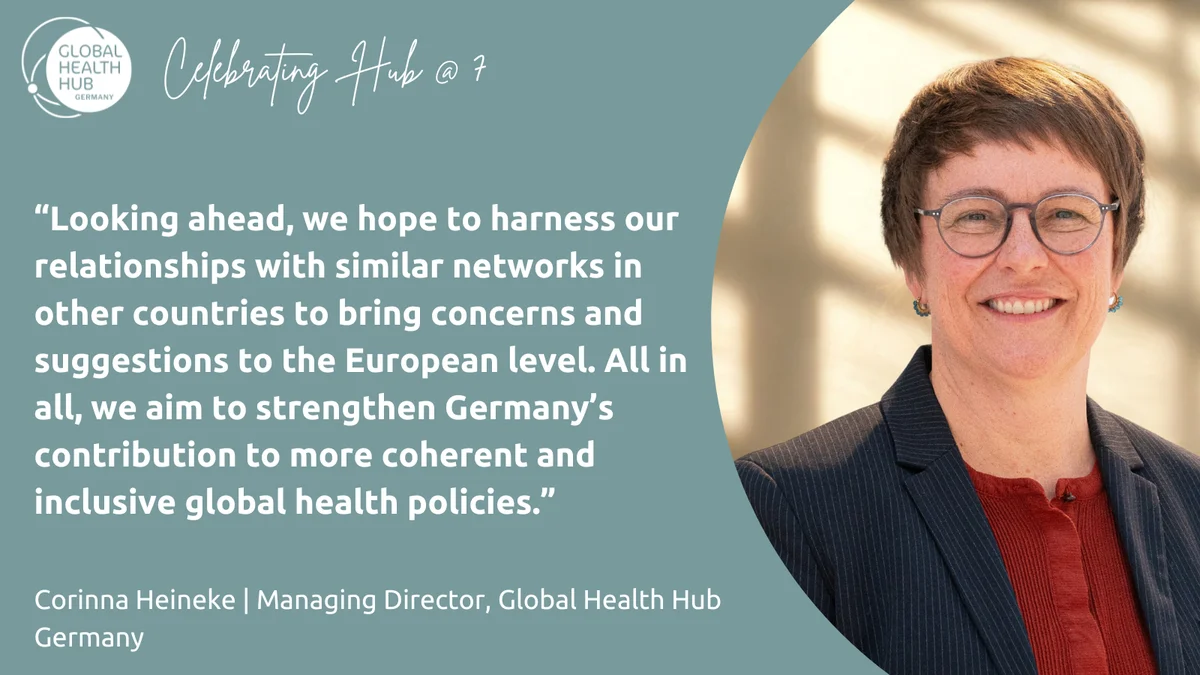
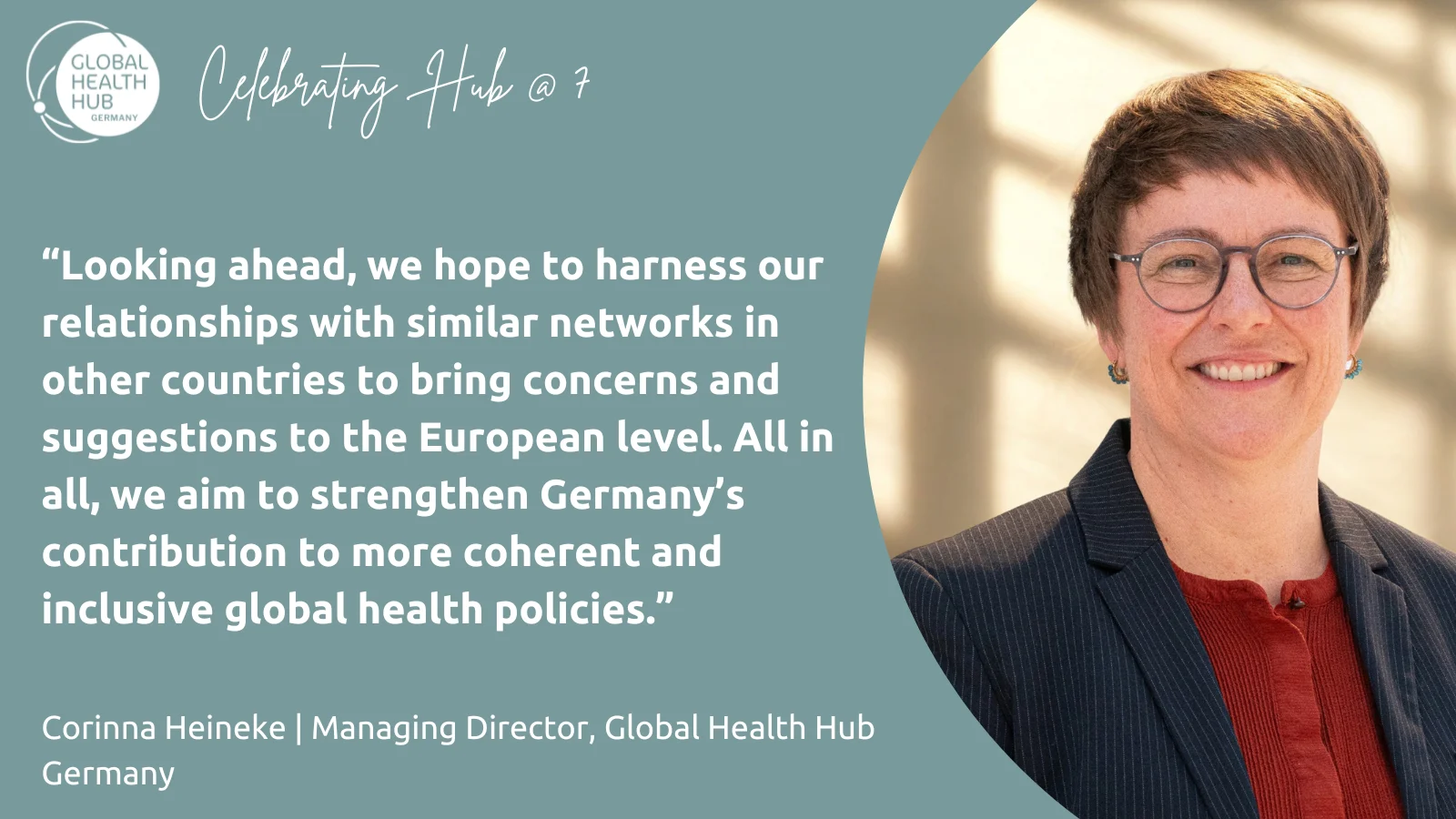
I very much hope that the Hub’s network and collaboration opportunities continue to be useful for its members and that we pool information in a way that is indispensable, both to our members and to political decision-makers. I would like to see more proactive use of the broad network by those of our members who are directly involved in developing national health strategies, for example. Furthermore, we can hopefully harness our relationship with similar networks in other countries to table concerns and suggestions at the European level. All in all, we hope to strengthen Germany’s contribution to more coherent and inclusive global health policies.
Related Articles
![[Translate to English:] ©GHHG](/fileadmin/_processed_/c/9/csm_GHHG_Team_37885962d7.webp "[Translate to English:] ©GHHG")